Boniface Mwangi pledges death penalty for corruption if elected president
By David Nthua, July 27, 2026Ukweli Party leader Boniface Mwangi has pledged to introduce the death penalty for people convicted of stealing public resources if elected president in 2027.
Mwangi shared a campaign video on X on Monday, July 27, 2026, outlining what he described as a tough approach to corruption.
“Nikiwa Rais wa Kenya, nitapambana na ufisadi bila woga. Sheria itabadilishwa ndio makosa ya ufisadi ipewe hukumu ya kifo,” Mwangi said.
He added that those found guilty of stealing public property would be prosecuted and hanged.
Mwangi was elected Ukweli Party leader in June as he prepares to seek the presidency in the August 2027 General Election.
Death penalty already exists in Kenya
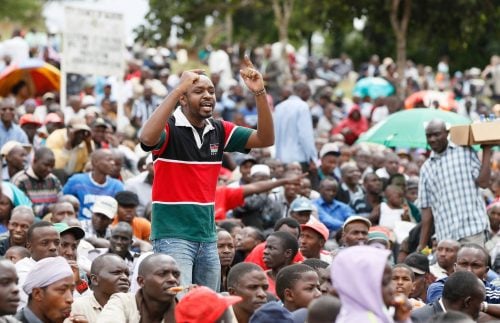
Mwangi’s proposal would not technically reintroduce the death penalty because it remains part of Kenyan law.
The Penal Code provides capital punishment for offences including murder, treason, robbery with violence and attempted robbery with violence. However, corruption is not currently classified as a capital offence.
Kenya has not carried out an execution since 1987. It is therefore classified as abolitionist in practice, despite courts retaining the legal power to impose death sentences.
Former presidents Mwai Kibaki and Uhuru Kenyatta commuted thousands of death sentences. President William Ruto also commuted death sentences imposed by November 21, 2022, to life imprisonment.
The Supreme Court ruled in the 2017 Muruatetu case that the mandatory death penalty for murder was unconstitutional.
The ruling did not abolish capital punishment itself. It required courts to consider mitigation before sentencing.

Mwangi would need Parliament’s support
A president cannot independently introduce a new punishment for corruption.
Parliament would have to amend the Anti-Corruption and Economic Crimes Act or another criminal statute to classify specified corruption offences as punishable by death.
The current law allows a fine of up to Ksh1 million, imprisonment of up to 10 years or both. Courts may also impose an additional mandatory fine linked to the benefit received or public loss suffered.
Any attempt to amend the constitutional right to life would require a referendum because Article 255 protects changes affecting the Bill of Rights.
A constitutional amendment can be introduced through Parliament under Article 256 or through a popular initiative backed by at least one million registered voters under Article 257.
A parliamentary amendment requires the support of at least two-thirds of members in both Houses.
However, Article 26 already allows intentional deprivation of life where authorised by the Constitution or written law.

This means Parliament could first attempt to introduce Mwangi’s proposal through ordinary legislation. Such a law would almost certainly face a constitutional challenge over proportionality, human dignity and the right to life.
Countries retaining capital punishment
Countries that retain the death penalty include China, Iran, Saudi Arabia, India, Japan, Singapore, Somalia, Botswana and the United States.
Amnesty International says more than two-thirds of countries have abolished capital punishment in law or practice.
Kenya is among states that retain it in law but have not executed anyone for more than 10 years.
Mwangi’s proposal now places capital punishment at the centre of his anti-corruption platform. It also opens a wider debate on whether harsher sentences would reduce graft or weaken constitutional protections.
s