World Bank: Why higher taxes have not solved Kenya’s revenue problem
By Aloys Michael, July 14, 2026Kenya’s tax burden has risen steadily in recent years, yet government revenue continues to fall short of fiscal needs, leaving policymakers struggling to narrow budget deficits and reduce borrowing.
According to the latest World Bank Kenya Economic Update, the problem is not simply that Kenya needs more taxes. Rather, revenue collection has failed to keep pace with spending pressures, debt obligations and the structural challenges that limit the government’s ability to convert economic activity into sustainable revenue.
The report provides a clear answer to questions frequently asked by businesses, investors and taxpayers: Why are taxes increasing in Kenya? Is Kenya collecting enough taxes? Why does Kenya continue to run budget deficits? The World Bank’s assessment suggests that higher taxes alone cannot solve Kenya’s revenue problem because revenue mobilisation remains constrained by compliance gaps, a large informal economy, economic shocks and persistent fiscal pressures.
“Revenue shortfalls have continued to weigh on fiscal consolidation efforts,” the report notes, adding that it has complicated the government’s efforts to reduce deficits and stabilise public finances at a time when expenditure demands remain elevated. Kenya continues to require significant resources for debt servicing, infrastructure investment, healthcare, education and social protection programmes, increasing pressure on the Treasury to raise additional revenue.
The challenge has become more urgent as public debt remains elevated. According to the World Bank, public debt reached 70.2 per cent of GDP by the third quarter of the 2025/26 fiscal year. Debt servicing obligations consume a substantial share of government resources, leaving less room for development spending and increasing the need for stronger domestic revenue mobilisation.
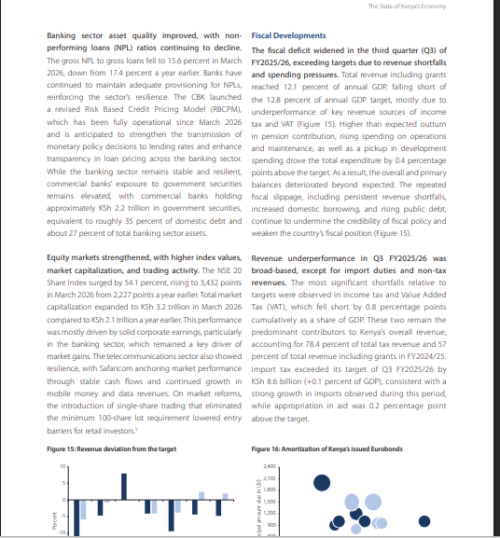
Revenue gap
The World Bank argues that Kenya’s fiscal challenge is not solely a tax policy issue but a broader revenue mobilisation problem. While tax rates and tax measures often dominate public debate, actual collections have repeatedly underperformed government targets. As a result, budget deficits persist even when new taxes are introduced.
The report highlights how economic shocks can weaken the tax revenue that Kenyan authorities can collect. Higher fuel prices linked to conflict in the Middle East increased production and transport costs, reduced purchasing power and slowed activity in some sectors of the economy. Such shocks affect business profitability, consumer spending and ultimately tax collections.
“Strengthening domestic revenue mobilisation remains critical for fiscal sustainability,” the World Bank states.
The institution argues that improving tax administration may be as important as introducing new tax measures. Better compliance systems, stronger enforcement, expanded digital tax collection tools, and more efficient administration could help increase collections without imposing excessive burdens on compliant taxpayers.
Another major challenge is the size of Kenya’s informal economy. Millions of workers and small businesses operate outside the formal tax net, limiting the government’s ability to collect revenue from a large share of economic activity. This means formally registered businesses and salaried employees often shoulder a disproportionate share of the Kenyan tax burden while substantial economic activity remains untaxed.

Beyond higher taxes
The World Bank’s findings suggest that sustainable revenue growth will depend on broader fiscal reforms Kenya has been pursuing rather than relying primarily on higher taxes. Improving compliance, expanding the tax base, reducing leakages and strengthening public financial management could generate more durable gains than repeatedly increasing tax rates.
The report also emphasises the importance of expenditure discipline. Even strong revenue growth may struggle to keep pace with rising spending pressures if public finances are not managed efficiently. This is one reason why the fiscal reforms Kenya policymakers are implementing focus on both revenue mobilisation and expenditure controls.
“High public debt and persistent fiscal pressures continue to constrain fiscal space,” the World Bank warns. The statement highlights the broader challenge facing Kenya’s tax policy: balancing the need for higher revenue with the need to support economic growth, investment and job creation.
The World Bank observes that Kenya’s budget deficits are not simply the result of insufficient taxes. They reflect a combination of revenue underperformance, elevated debt obligations, economic shocks and structural weaknesses in revenue collection.
While Kenya taxes may continue to play a central role in fiscal policy, the report argues that the country’s long-term fiscal health will depend on building a more efficient, transparent and inclusive revenue system. Higher taxes may raise additional revenue in the short term, but without stronger administration, broader compliance and deeper fiscal reforms, they are unlikely to resolve Kenya’s revenue challenges on their own.