UN: Why your certificate might not matter anymore in job market
By Aloys Michael, July 8, 2026For decades, a university degree was the golden ticket to a good job. Parents sacrificed, students borrowed, and governments expanded higher education on the promise that more credentials meant better lives.
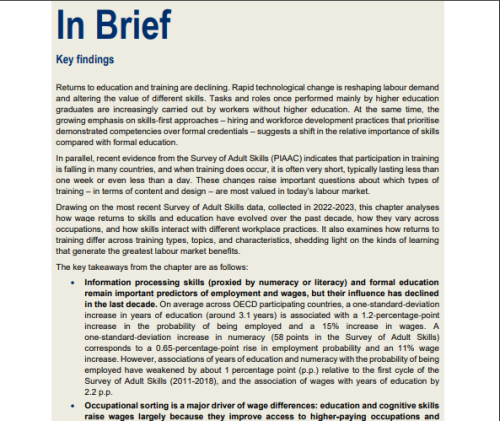
But the OECD Employment Outlook 2026, released on Tuesday, July 7, 2026, finds that cognitive skills and formal education remain important, but their influence has weakened over the past decade.
On average across OECD countries, the association between years of education and wages fell by 2.2 percentage points between the survey cycles. What’s rising in value? Non-cognitive skills, teamwork, decision-making, and autonomy are becoming the new currency of the labour market.
“This isn’t just an OECD quirk; it’s a global trend. Employers are increasingly asking not Where did you go to school? But what can you actually do?” the report reads in part.
According to the OECD, skills-first approaches have gained traction as a way to better align the skills employers demand with those workers possess. Leading firms have removed degree requirements for many roles, using practical assessments to find people who can do the work regardless of how they learned to do it.
For East Africa, this shift is both a warning and an opportunity. Across the region, university expansion has produced millions of graduates, but formal-sector jobs haven’t kept pace.
“A similar pattern is visible in India, where under 7% of Indian graduates secure a permanent salaried job within a year of graduating, despite spending lakhs on degrees.”
The Kenyan reality is familiar: graduates with impressive certificates struggle to find work, while those with demonstrable skills, even without formal credentials, often fare better.
“Occupational sorting accounts for a substantial share of variation in wages. What you know matters less than where your skills can take you,” the OECD report notes.

What employers actually want
The data is clear on what drives wages.
The OECD finds that “a higher degree of task discretion and co-operation in one’s job is associated with higher wages.”
Skills like influencing others and self-organisation now command premium returns. In the United States, a one-standard-deviation increase in the use of influencing skills corresponds to a 7 per cent rise in hourly wages”.
The message isn’t that education doesn’t matter; it still does. But the era of a degree as a lifetime passport to prosperity is ending.
“Skills-first approaches remove the notion of a fixed endpoint to learning and instead frame skills development as a continuous, lifelong process,” the report states.
For job seekers, this means prioritising demonstrable competencies over paper qualifications. For employers, it means looking beyond credentials to actual capabilities.
And for governments, it means rethinking education systems to build flexible, skills-based pathways, not just more universities.