Treasury cuts Kenya’s external debt by Ksh12.6B as stronger shilling lowers loan burden
By Aloys Michael, July 8, 2026Kenya’s external debt declined by Ksh12.59 billion in April 2026, offering a rare bright spot in the country’s public debt profile as repayments and a stronger Kenya shilling combined to reduce the government’s foreign loan burden.
The latest National Treasury Public Debt Bulletin shows that Kenya’s external debt stock fell from Ksh5,683.22 billion at the end of March to Ksh5,670.63 billion by the close of April. The Treasury attributed the decline to scheduled loan repayments and favourable exchange rate movements that reduced the shilling value of foreign-denominated debt.
“The total external debt stock decreased on account of repayments and exchange rate movements by Ksh12.59 billion from Ksh5,683.22 billion at the end of March 2026 to Ksh5,670.63 billion as at the end of April 2026,” the Treasury said in the bulletin.
The decline marks a significant departure from the narrative that Kenya’s debt is only moving in one direction. While the country’s total public debt remained high at Ksh12,856.40 billion, the reduction in external obligations suggests recent debt management measures are beginning to ease pressure on foreign borrowing.
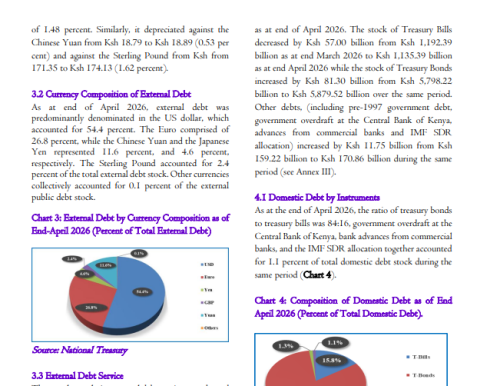
A key factor behind the improvement was the performance of the Kenya shilling. During April, the local currency appreciated from Ksh129.93 to Ksh129.19 against the US dollar, representing a 0.57 per cent gain. It also strengthened by 1.02 per cent against the Japanese yen, moving from Ksh81.48 to Ksh80.65 per 100 yen. Since a large share of Kenya’s external debt is denominated in these currencies, the appreciation helped lower the shilling value of outstanding loans.
The Treasury noted, however, that the shilling weakened against the euro, Chinese yuan and the British pound during the same period, partially offsetting the gains recorded against the dollar and yen.
Commercial debt recorded the sharpest decline among Kenya’s external creditors. According to the bulletin, commercial external debt fell by Ksh20.81 billion, dropping from Ksh1,574.19 billion in March to Ksh1,553.39 billion in April. Guaranteed debt also declined by Ksh0.68 billion, while bilateral and multilateral debt registered modest increases during the month.
Kenya’s debt
The report further shows that the US dollar remains the dominant currency in Kenya’s external debt portfolio, accounting for 54.4 per cent of all foreign obligations. The euro represents 26.8 per cent, followed by the Chinese yuan at 11.6 per cent and the Japanese yen at 4.6 per cent. This currency mix means fluctuations in exchange rates have a direct impact on how much the government ultimately pays to service external loans.

For taxpayers, a stronger shilling can translate into lower debt servicing costs because fewer Kenyan shillings are required to repay loans denominated in foreign currencies.
Conversely, a weakening shilling increases repayment costs and places additional pressure on public finances.
The Treasury also reported that cumulative external debt service reached Ksh633.08 billion by the end of April against a financial year budget of Ksh673.76 billion. During April alone, external debt service amounted to Ksh44.24 billion, comprising Ksh23.21 billion in principal repayments and Ksh21.03 billion in interest payments.
The reduction in external debt comes as Kenya continues implementing a broader debt management strategy aimed at lowering foreign exchange risks, smoothing future loan repayments and improving investor confidence.
On January 28, 2026, Moody’s upgraded Kenya’s long-term issuer ratings to B3 from Caa1, citing stronger external liquidity, improved foreign exchange reserves and successful Eurobond liability management operations.