Treasury assures no introduction of new taxes in 2026 finance bill
By Faith Lagat, March 27, 2026The National Treasury has assured Kenyans and Parliament that the upcoming 2026 Finance Bill will not introduce new taxes or increase existing tax rates.
The commitment aims to ease public concerns and promote economic stability following controversies over taxation in previous years.
On Thursday, March 26, 2026, in Kiambu County, Cabinet Secretary for the National Treasury John Mbadi appeared before the National Assembly Committee on Budget and Appropriation, chaired by Alego Usonga MP Sam Atandi, to discuss the FY 2025/26 Supplementary Budget Estimates 1.
During the session, Mwengi Mutuse, MP for Kibwezi West, raised questions about the approaching 2026 Finance Bill period, recalling near-unrest in 2024 linked to perceptions of tax hikes.
“I want to state that we are not looking at a possibility of increasing tax rates because there is no difference of this year and last year. Kenyans are the same and the rates are still the same,” Mbadi told the committee.
He added that the government will instead focus on expanding the tax base without burdening current taxpayers.
Focus on revenue collection and automation
Mbadi highlighted challenges in revenue collection, noting that while many taxpayers have embraced digital platforms, the Kenya Revenue Authority (KRA) still relies heavily on manual processes.
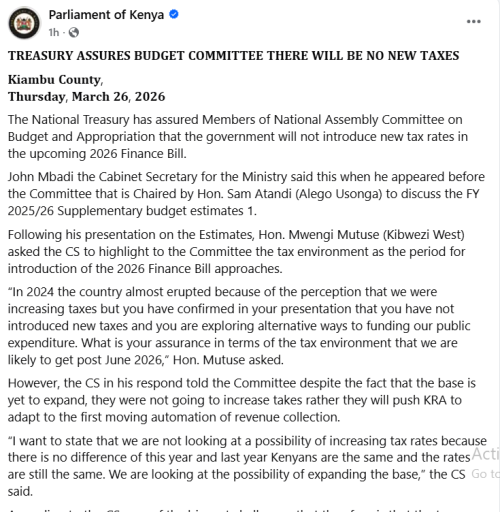
“I know this has been talked about a lot, and the base is not expanding as expected, but we are putting pressure on KRA, and some changes must be seen in terms of revenue collection. Failure to which we must make reforms to adapt to the fast-moving automation of revenue collection,” he said.
The Treasury plans to modernise operations through automation, aiming to capture revenue efficiently while avoiding additional tax burdens.
This approach comes after lessons learned from the 2024 anti-Finance Bill protests, which highlighted public resistance to perceived new taxes.
Preparedness for economic shocks
Mbadi also addressed concerns about global disruptions, including the Middle East conflict and potential fuel hoarding by oil marketers.
He noted that government-to-government arrangements are in place, with partners working to ensure fuel security, while stressing that no country can fully anticipate abrupt shocks like wars or pandemics.
The committee also received reports from chairpersons of departmental committees on Education, Finance and National Planning, and Blue Economy, Water and Irrigation, regarding the supplementary estimates.