Suburban house prices lead Nairobi property market growth in early 2026
By Kenneth Mwenda, May 3, 2026Property sales in Nairobi’s suburbs rose by 1.1 per cent in the first quarter of 2026. This marked an improvement from the 0.8 per cent growth recorded in the previous quarter. Rental prices also increased by 1.3 per cent during the same period.
HassConsult Real Estate Limited released its House Price Index for the quarter in late April 2026. The report shows that demand for standalone houses supported the suburban market. Buyers continued to seek these units despite economic pressures. In contrast, apartment sales remained sluggish and contributed to oversupply in some areas.
Lavington led house price growth in the suburbs with a 4.2 per cent quarterly rise. Spring Valley followed at 4.0 per cent, while Kilimani recorded 3.9 per cent. Karen, Loresho, and Westlands each grew by 3.8 per cent. In the apartment segment, Muthangari and Riverside posted gains of 3.8 per cent and 1.8 per cent respectively. However, prices fell in Westlands by 2.8 per cent and in Upperhill by 2.5 per cent.
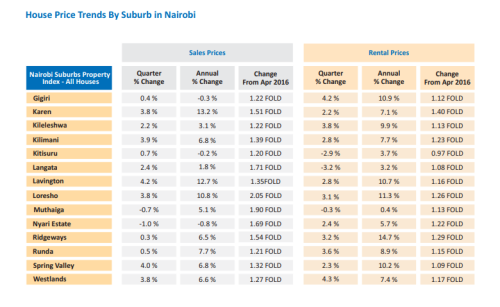
Satellite towns faced tougher conditions. Prices for new units contracted by 0.9 per cent in the quarter. This followed marginal growth of 0.1 per cent in the fourth quarter of 2025. The middle class, which drives most demand in these areas, struggled with reduced purchasing power.
Sakina Hassanali, HassConsult Co-CEO and Creative Director, explained the trends. “House sale price growth in the suburbs partly stems from undersupply of units and bullish increases in many city suburbs, led by the likes of Lavington and Spring Valley,” she said. “The correction in apartment prices reflected increased supply, moving to saturation in some areas.”
“In the satellite towns, rising living costs and limited household incomes reduced buyers’ ability to afford homes, leading to price correction in both houses and apartments segments,” Hassanali added.
Rent growth, market shifts
Rental prices continued to rise, though at a slower pace. Satellite towns saw a 1.4 per cent increase, while suburbs recorded 1.3 per cent. Westlands and Gigiri led house rent growth in suburbs at 4.3 per cent and 4.2 per cent. Langata posted the largest declines, with house rents down 3.2 per cent and apartment rents down 2.9 per cent. In satellite towns, Juja and Ngong led gains, while Kiserian and Ruiru saw drops.
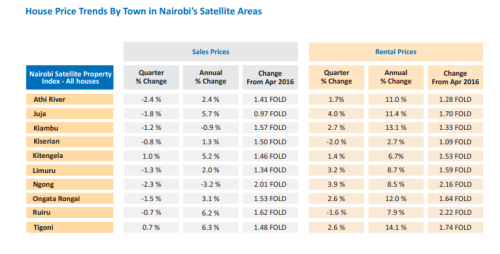
Average rents in suburbs crossed Ksh200,000 for the first time, reaching Ksh201,832. Satellite towns hit a record high of Ksh64,765. These levels kept rental yields healthy at 7.4 per cent in suburbs and 5.3 per cent in satellite towns. Both compare well with returns from short-term government securities.
The data points to mounting affordability pressure, especially in satellite towns. While suburban houses showed strength, the overall market reflected caution among buyers. HassConsult noted that property values have risen significantly since 2001, but current economic realities now shape short-term movements.