Salasya demands answers from Ruto over KPC privatisation plan
By Faith Lagat, January 5, 2026Mumias East Member of Parliament Peter Salasya has questioned the government’s plan to privatise the Kenya Pipeline Company (KPC), directing his concerns to President William Ruto and his administration.
In a post shared on X on January 5, 2025, Salasya challenged the rationale behind listing the state-owned firm on the stock exchange, citing its profitability and strategic role in the country’s energy sector.
“I wish to raise a pertinent and unavoidable national question directly to H.E. President William Ruto and his administration regarding the proposed privatisation of the Kenya Pipeline Company (KPC),” Salasya wrote.
He argued that companies taken to the stock exchange are usually those seeking capital or facing unstable earnings.
“Mr. President, companies that are ordinarily taken to the stock exchange are either new, capital-starved enterprises, or firms whose profits are unpredictable and require public investment to stabilise and grow.KPC does not fall into either category.”
Questions over KPC’s financial status
Describing KPC as a fully established strategic national asset with infrastructure already laid across the country, a guaranteed market, and stable, predictable revenues, Salasya questioned the financial justification for privatisation. “I therefore ask, when did KPC become a loss-making or financially unstable company to justify this move? Kenyans deserve a clear, factual answer.”
He further demanded clarity if the intention is to raise capital.
“If the justification is to ‘raise capital,’ then the government must candidly explain what specific projects KPC is unable to undertake with its current revenues, and how listing it on the stock exchange will improve its performance beyond what it already delivers,” he added.
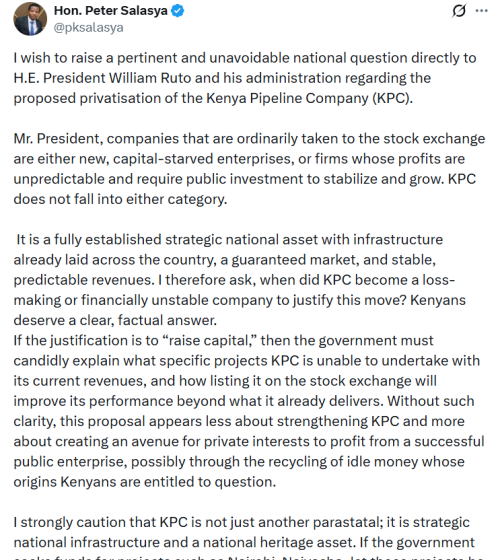
Salasya also warned that without such explanations, the proposal appears less about strengthening KPC and more about creating an avenue for private interests to profit from a successful public enterprise, possibly through the recycling of idle money whose origins Kenyans are entitled to question.
Concerns over strategic assets
Salasya cautioned against treating KPC as an ordinary parastatal, calling it strategic national infrastructure and a national heritage asset.
He proposed alternative financing methods, stating: “If the government seeks funds for projects such as Nairobi–Naivasha, let those projects be taken directly to the stock exchange or financed through infrastructure bonds. Do not mortgage or dilute ownership of KPC in the process. Kenyans did not elect leaders to sell everything that works. We must draw the line and protect our strategic institutions for the present and future generations.”
His remarks follow earlier criticism of the government’s privatisation agenda. On December 15, 2025, he rebuked Thika MP Alice Wambui Ng’ang’a over remarks suggesting the sale of Safaricom or KPC.
Salasya likened such proposals to irresponsible disposal of inherited property.
The government plans to sell a 65 percent stake in KPC through an initial public offering by March 31, 2026, following parliamentary approval in October 2025.