Relief at the pump as EPRA lowers fuel prices
By Kenneth Mwenda, February 14, 2026The Energy and Petroleum Regulatory Authority (EPRA) has lowered maximum retail fuel prices for the period running from February 15, 2026, to March 14, 2026, offering motorists and households some relief at the pump.
In the latest monthly review, Super Petrol will drop by Ksh4.24 per litre, Diesel by Ksh3.93 per litre, and Kerosene by Ksh1.00 per litre. The revised prices take effect at midnight.
EPRA Director General Daniel Kiptoo Bargoria signed the announcement on February 14, 2026, and outlined the legal basis for the review.
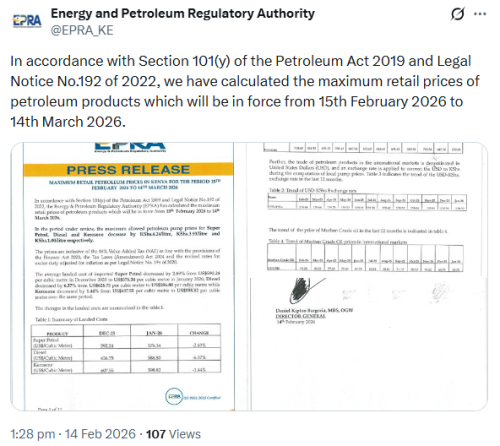
“In accordance with Section 101(y) of the Petroleum Act 2019 and Legal Notice No.192 of 2022, the Energy & Petroleum Regulatory Authority (EPRA) has calculated the maximum retail prices of petroleum products which will be in force from 15th February 2026 to 14th March 2026,” he said in the official release.
Nairobi prices
Under the new schedule, motorists in Nairobi will pay a maximum of Ksh178.28 per litre for Super Petrol, Ksh166.54 for Diesel, and Ksh152.78 for Kerosene. These prices include 16 per cent Value Added Tax, as provided under the Finance Act 2023 and the Tax Laws (Amendment) Act 2024, as well as inflation-adjusted excise duties under Legal Notice No. 194 of 2020.
EPRA attributed the reductions mainly to lower landed costs of imported fuels. Kenya imports all its refined petroleum products and purchases them on the international market using global benchmarks.
Other cities
Under the new review effective February 15, 2026, Super Petrol in Mombasa retails at Ksh175.00 per litre, Diesel at Ksh163.26 and Kerosene at Ksh149.49. In Nakuru, motorists pay Ksh177.99 for Super Petrol, Ksh165.95 for Diesel and Ksh152.21 for Kerosene.
Eldoret records Ksh178.16 for Super Petrol, Ksh166.77 for Diesel and Ksh153.03 for Kerosene.
The average landed cost of Super Petrol fell by 2.69 per cent, from US$592.24 per cubic metre in December 2025 to US$576.34 in January 2026. Diesel recorded a sharper decline of 6.37 per cent, dropping from US$626.75 to US$586.80 per cubic metre over the same period. Kerosene decreased by 1.44 per cent, from US$607.55 to US$598.82 per cubic metre.
Global prices drive changes
International price movements over the past year show significant fluctuations. Super Petrol prices in US dollars per metric tonne ranged from a high of US$728.64 in September 2025 to US$642.73 in January 2026. Diesel traded between US$563.84 in May 2025 and US$669.43 in November 2025. Kerosene varied from US$598.43 in May 2025 to US$720.56 in November 2025.
The exchange rate between the US dollar and the Kenyan shilling has remained relatively stable over the past 12 months, hovering between Ksh129 and Ksh130. In January 2026, the rate stood at Ksh129.97. A steady exchange rate has helped cushion consumers from sharper increases that often arise when the shilling weakens.
Murban Crude Oil prices, which serve as a key international reference, have also declined in recent months. The price dropped from US$80.22 per barrel in March 2025 to US$65.53 in January 2026. Lower crude prices generally reduce the cost of refined products, although other factors such as freight, insurance and taxes also affect final pump prices.
EPRA caps retail prices to ensure oil marketing companies recover importation and other prudently incurred costs while keeping prices fair for consumers. The authority said it remains committed to promoting fair competition and protecting both consumers and investors in the energy and petroleum sectors.
The revised prices will apply nationwide, although pump prices vary slightly across towns due to transport and distribution costs. EPRA has listed the town-by-town adjustments in Annex I of its summary, while Annex II provides a detailed breakdown of cost components for Nairobi.