Oil prices fall after de-escalation of Iran war
By Faith Lagat, June 21, 2026Oil prices fell this week despite renewed tensions around the Strait of Hormuz, as markets responded to easing geopolitical risks ahead of planned talks between the United States and Iran in Switzerland.
According to the Central Bank of Kenya (CBK) Weekly Bulletin released on June 19, 2026, Murban crude oil prices dropped to about Ksh10,983 from Ksh12,496 per barrel recorded a week earlier. The decline came even after Iran announced the closure of the Strait of Hormuz following Israeli military strikes in Lebanon.
“Inflation pressures eased during the week ending June 18, 2026, following the US-Israel-Iran ceasefire deal. The Federal Reserve Bank and the Bank of England retained their policy rates amid easing geopolitical risks, even as concerns over second-round inflation pressures persisted. The U.S. Dollar Index strengthened by 0.8 per cent during the week,” read the CBK X post in part.
Easing oil prices are expected to offer temporary relief to oil-importing countries, including Kenya, where fuel costs remain a key driver of inflation and economic activity.
Oil prices decline amid ceasefire optimism
According to the BBC, the drop in global oil prices followed the signing of a preliminary ceasefire agreement between the US and Iran aimed at ending the conflict that has affected parts of the Middle East since February.
The agreement calls for an immediate halt to hostilities and sets the stage for negotiations over the next 60 days. Markets reacted positively to the development, with inflation pressures easing during the week ending June 18.
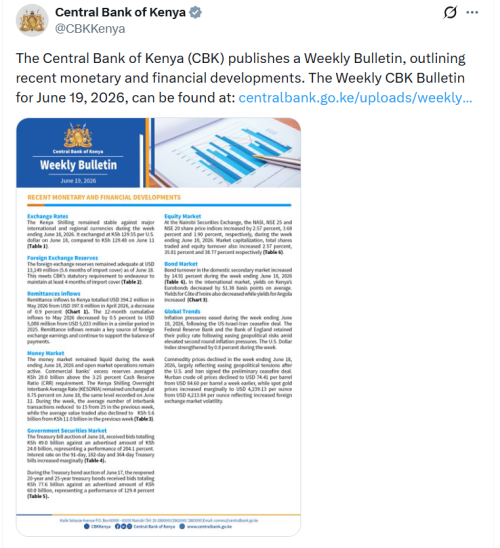
The CBK noted that the US Federal Reserve and the Bank of England maintained their policy rates as policymakers weighed easing geopolitical tensions against persistent inflation concerns.
The US Dollar Index strengthened by 0.8 per cent during the week, while spot gold prices rose slightly to about Ksh626,077 per ounce from Ksh622,345 amid continued foreign exchange market volatility.
Strait of Hormuz dispute raises fresh concerns
Despite the easing of oil prices, tensions resurfaced after Iran’s Islamic Revolutionary Guard Corps announced that the Strait of Hormuz had been closed again, citing Israeli military operations in southern Lebanon.
Iran argued that the attacks violated the terms of the recently signed US-Iran agreement and accused Washington of failing to implement commitments contained in the 14-point memorandum signed earlier this week.
The Strait of Hormuz remains one of the world’s most important energy corridors, handling approximately one-fifth of global oil supplies.
However, the United States rejected claims that shipping had been halted.
Central Command spokesperson Tim Hawkins stated that “traffic continues to flow” through the waterway and maintained that Iran does not control access to the strait.
According to US military data, 55 merchant vessels carrying more than 17 million barrels of oil transited the route on Saturday. Shipping tracking data also indicated continued tanker movement through the area despite heightened tensions.
US-Iran talks set to begin in Switzerland
Attention is now shifting to direct negotiations scheduled to begin in Switzerland on Sunday, June 22.
US Vice-President JD Vance travelled to Switzerland to lead the American delegation, while Iran is represented by parliamentary speaker Mohammad Bagher Ghalibaf and Foreign Minister Abbas Araghchi.
Pakistan Prime Minister Shehbaz Sharif is expected to participate as a mediator after previously facilitating discussions between the two countries.
Vance said progress had been made in reducing violence but acknowledged that challenges remained, particularly regarding security in Lebanon.
Meanwhile, clashes continued on the ground despite ceasefire efforts. Lebanese authorities reported dozens of deaths from Israeli strikes on Saturday, while the Israeli military said it had targeted Hezbollah positions in southern Lebanon.