National Infrastructure Fund raises Ksh129B in 4 months
By Kenneth Mwenda, May 12, 2026President William Ruto has said the government has raised about USD1 billion, equivalent to roughly Ksh129 billion, through the National Infrastructure Fund (NIF) within four months of its launch.
Ruto made the remarks on Tuesday, May 12, 2026, during the Africa Forward Summit 2026 held in Nairobi and co-hosted with French President Emmanuel Macron. He said the money was mobilised locally through Public-Private Partnerships (PPPs) and other domestic investment channels.
“Through the establishment of the National Infrastructure Fund, a platform designed to mobilise long-term domestic capital into strategic national projects, our new National Infrastructure Fund has mobilised approximately USD1 billion in the last four months, demonstrating the enormous potential that exists within African economies themselves,” Ruto said.
The National Infrastructure Fund became law in March after Parliament passed the National Infrastructure Fund Bill, 2026. The government expects the fund to mobilise nearly Ksh5 trillion over the next 10 years to finance large infrastructure projects across the country.
The plan marks a major shift in how Kenya intends to finance development. Instead of depending heavily on external borrowing from lenders such as the World Bank and the International Monetary Fund (IMF), the government wants to attract investment from local and international private investors.
The fund will support projects in transport, energy, ports, agriculture and housing. The government says the model will allow Kenya to build major infrastructure while reducing pressure on public debt.
Ruto told delegates at the summit that Kenya wants to position itself as an investment partner rather than a country waiting for aid.
“With President Macron in attendance, we are building partnerships where Africa is not just a recipient of aid but an active investor alongside partners like France,” he said.
He added that the government is working to create systems that allow private investors to put money into public infrastructure projects safely while still making returns.
“As government, we are deliberately partnering with the private sector to build confidence, reduce risk, and crowd in investment into transformative public infrastructure,” Ruto said.
KPC IPO drives fund
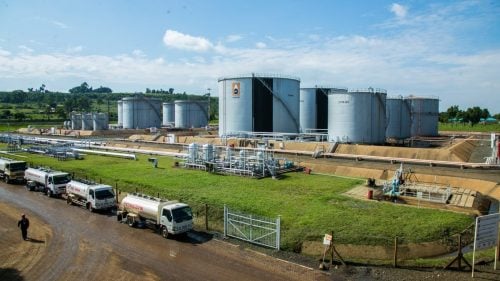
A large share of the Ksh129 billion already raised came from the Kenya Pipeline Company (KPC) Initial Public Offering (IPO), which brought in about Ksh106.7 billion in April. Ruto had earlier described the KPC IPO as the “seed capital” for the new fund.
When signing the NIF Bill into law at State House in March, the president said the government planned to use the initial capital to attract even more investment into the economy.
“I will be at the NSE to ring the bell and complete the privatisation of the KPC IPO and raise Ksh106 billion that will be the seed money for the National Infrastructure Fund,” he said at the time.
“Our goal is to leverage this capital at least two times what we will get from the Kenya Pipeline IPO. Over time, this model will enable Kenya to mobilise about Ksh5 trillion.”
The government has identified several flagship projects to be financed through the fund. One of the first is the planned expansion of Jomo Kenyatta International Airport, including a new passenger terminal and a 4.8-kilometre runway.
Ruto has also said the fund will support the proposed East African Oil Refinery project linked to Nigerian businessman Aliko Dangote. Under the arrangement, the NIF would co-invest in the project to lower investment risks and allow the government to benefit from future profits.
The president said the fund will also help the government take part in commercially viable infrastructure investments instead of only financing projects through loans.
“We will use the fund to de-risk investments so that when projects become profitable, the government and the people of Kenya also benefit from the returns,” he said.
The establishment of the fund, however, has faced criticism from some oversight institutions and financial experts.
Concerns over fund governance
Before the Bill was passed, Controller of Budget Margaret Nyakang’o raised concerns about the governance structure of the fund. Her office argued that the proposed law did not clearly explain oversight mechanisms or how withdrawals from the fund would be authorised.
The Institute of Certified Public Accountants of Kenya (ICPAK) and the Institute of Public Finance also questioned whether the fund should be managed directly under the National Treasury. They called for stronger transparency measures and more independent oversight.
In response to some of the concerns, Parliament amended the Bill to strengthen accountability. The law now requires the Treasury Cabinet Secretary to submit the fund’s investment policy to Parliament within 90 days for approval, amendment or rejection.
The government has already appointed a governing council to oversee the fund. Treasury Cabinet Secretary John Mbadi chairs the council, alongside Central Bank Governor Kamau Thugge and Attorney General Dorcas Oduor.
Independent members include KCB Group chief executive Paul Russo and former president of the African Export-Import Bank Benedict Oramah.
The government says the National Infrastructure Fund will help Kenya close its infrastructure financing gap while attracting long-term investment into the economy.