Advertisement
National Assembly raises alarm over unclear ownership of Miwani Sugar land
Wednesday 25th March, 2026 10:55 AM|

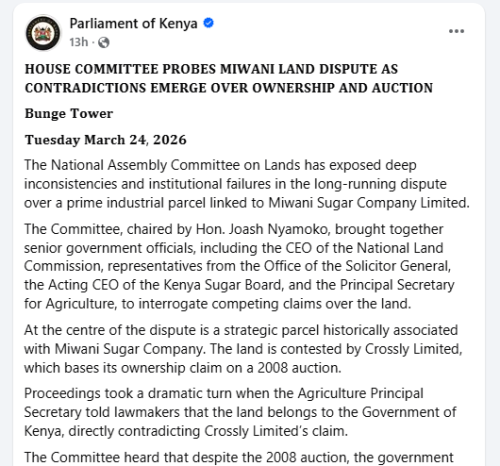
The National Assembly Committee on Lands has uncovered significant institutional failures and deep inconsistencies regarding the ownership of a prime industrial land parcel linked to Miwani Sugar Company Limited.
According to a Parliament of Kenya report, the probe focuses on inconsistencies in court rulings and gaps in government oversight that have left ownership unclear for over a decade.
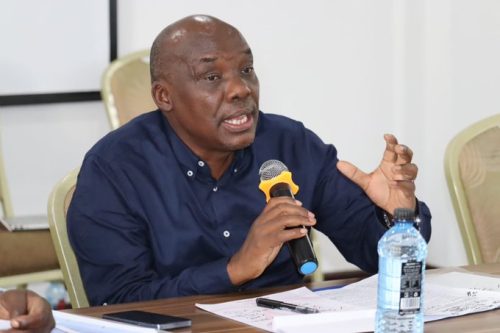
The National Assembly Committee on Lands, chaired by Joash Nyamoko, on Tuesday, March, 24, 2026 brought together senior government officials, including the CEO of the National Land Commission (NLC), the Acting CEO of the Kenya Sugar Board, representatives from the Office of the Solicitor General, and the Agriculture Principal Secretary, to scrutinise competing claims over the land.
At the centre of the dispute is a strategic parcel historically associated with Miwani Sugar Company. Crossly Limited asserts ownership based on a 2008 auction.
Crossly Limited Ownersip
You Might Also Like


While Crossly Limited bases its ownership on a 2008 auction, the Principal Secretary for Agriculture testified that the land remains government property.
“Proceedings took a dramatic turn when the Agriculture Principal Secretary told lawmakers that the land belongs to the Government of Kenya, directly contradicting Crossly Limited’s claim. The Committee heard that despite the 2008 auction, the government never received any proceeds from the transaction,” Parliament of Kenya statement read.
The Committee heard that despite the 2008 auction, no proceeds were ever received by the government.
The MPs questioned how such a transaction could occur without payment reaching the purported owner, raising doubts about the auction’s legitimacy.
Conflicting Legal Positions
Complicating matters, the Court of Appeal later nullified the auction, yet Crossly Limited continues to assert ownership, creating conflicting legal positions.
“Lawmakers questioned how a sale of such magnitude could occur without payment reaching the alleged rightful owner, casting serious doubt on the legitimacy of the process. Further weakening Crossly’s position, the Court of Appeal of Kenya has since nullified the auction,” Parliament of Kenya statement read.
Despite this ruling, Crossly Limited continues to assert ownership, resulting to conflicting legal positions. The inquiry also revealed contradictions within Kenya’s legal framework. While the Court of Appeal nullified the auction, an earlier High Court ruling had favoured Crossly Limited.
After that ruling, the Agriculture Ministry sought advice from the Office of the Attorney General, which recommended facilitating the land transfer to Crossly – guidance now under sharp parliamentary scrutiny.
Committee members described the situation as deeply troubling, citing inconsistent court decisions, missing auction proceeds, and fragmented government actions.
“Following that decision, the Agriculture Ministry sought guidance from the Office of the Attorney General, which advised facilitating the transfer of the land to Crossly Limited — guidance now under sharp parliamentary review,” a Parliament of Kenya statement read.
Author
Emmanuel Rono
Rono is a digital journalist with a proven track record in newsroom leadership and content creation. Currently a Digital Writer for People Daily Digital, Emmanuel’s career is rooted in a lifelong passion for storytelling. Let's talk here: [email protected] or [email protected]
View all posts by Emmanuel RonoLatest News







Advertisement
More on Business