Motorists challenge EPRA over unchanged pump prices
By Aloys Michael, July 15, 2026The Motorists Association of Kenya (MAK) is demanding a complete overhaul of Kenya’s fuel pricing framework after the Energy and Petroleum Regulatory Authority (EPRA) maintained petrol, diesel and kerosene prices for the July-August 2026 pricing cycle.
In a statement on Wednesday, July 15, 2026, MAK said Kenyan motorists are being denied the benefits of falling global oil prices and has accused the current fuel pricing system of failing consumers. The association wants political influence removed from fuel price determination and is calling for a transparent, market-responsive approach to setting petroleum prices in Kenya.
The demand comes after EPRA announced on Wednesday, July 14, 2026, that fuel prices would remain unchanged for the period running until August 14, 2026.
Under the latest EPRA fuel price review, super petrol will continue retailing at Ksh214.03 per litre in Nairobi, diesel at Ksh222.86 per litre and kerosene at Ksh191.38 per litre.
EPRA said the unchanged fuel prices were made possible through government intervention aimed at cushioning consumers from fluctuations in global fuel prices. However, MAK disputed the explanation, arguing that motorists should have started seeing lower pump prices after a prolonged period of favourable international oil market conditions.
Fuel price dispute
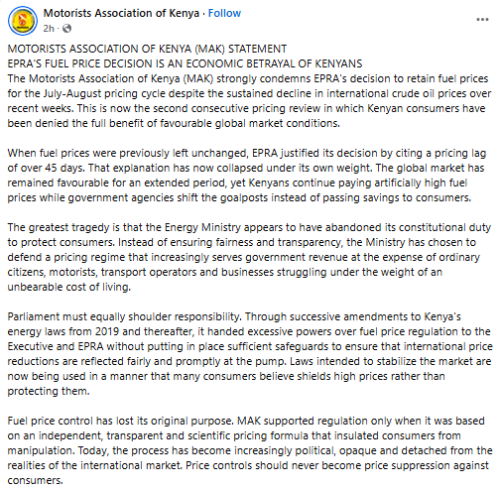
MAK challenged EPRA’s explanation that global fuel price changes take more than 45 days to reflect in Kenya’s local pump prices, saying the argument no longer justifies keeping prices unchanged.
“When fuel prices were previously left unchanged, EPRA justified its decision by citing a pricing lag of over 45 days. That explanation has now collapsed under its own weight,” MAK said.
The motorists’ lobby argued that Kenya’s fuel pricing formula should be more responsive to international market movements and should provide greater transparency on how petrol and diesel prices are calculated.
The association said motorists should benefit whenever global petroleum prices decline, instead of bearing high fuel costs despite changing market conditions.

Energy Act review
Beyond the latest EPRA fuel price announcement, MAK is pushing for reforms to Kenya’s petroleum laws, arguing that the Energy Act gives the Executive excessive influence over fuel pricing decisions without adequate public accountability.
The association has called on Parliament to urgently review the Energy Act and subsequent amendments, saying the current framework requires changes to protect consumers and improve transparency.
“We call upon Parliament to urgently review the Energy Act and all subsequent amendments that have concentrated excessive pricing powers in the Executive without adequate public accountability,” MAK said.
MAK added that any law that consistently disadvantages consumers while protecting government revenue requires immediate reconsideration.
Fuel prices remain a major economic concern in Kenya because changes in petrol and diesel costs directly affect transport fares, logistics expenses, food prices and the overall cost of living.
The association also accused the Ministry of Energy of failing to prioritise consumer protection and instead engaging in political matters outside its constitutional mandate.
The latest dispute has renewed debate over Kenya’s fuel pricing system, with motorists demanding reforms that would make pump prices more transparent, competitive and responsive to global oil market trends.