Mbadi leads Kenya in crucial World Bank talks on debt, economic stability
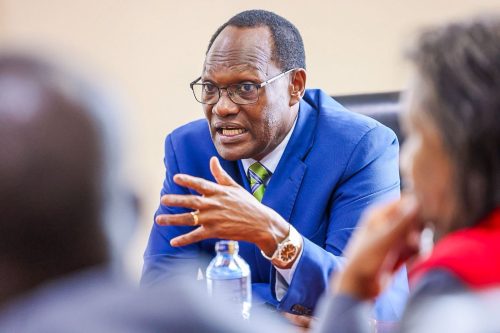
By Kiprono Keileb, October 14, 2025Kenya’s Treasury Cabinet Secretary John Mbadi has led a high-level delegation in key bilateral talks with the World Bank as the country continues efforts to stabilise its economy and strengthen fiscal reforms. The meeting took place during the ongoing IMF and World Bank Annual Meetings, where Mbadi met the Regional Vice President for Eastern and Southern Africa at the World Bank Group.
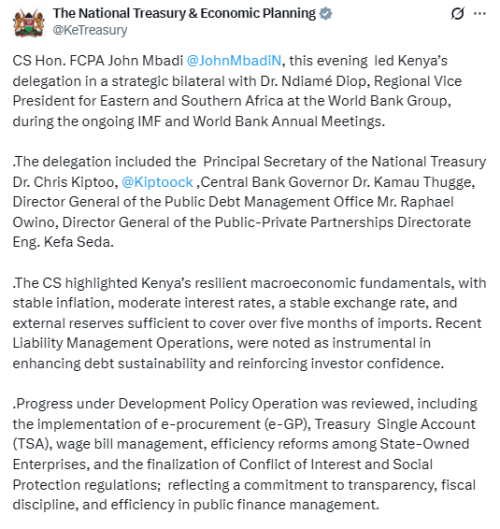
In a statement shared by the National Treasury on its official X account on Tuesday, October 14, 2025, Mbadi said the discussions focused on Kenya’s macroeconomic performance and ongoing financial reforms aimed at ensuring long-term stability.
According to the Treasury CS, Mbadi presented how Kenya is doing economically. “Mbadi highlighted Kenya’s resilient macroeconomic fundamentals, with stable inflation, moderate interest rates, a stable exchange rate, and external reserves sufficient to cover over five months of imports,” the statement reads
The meeting also recognised the Liability Management Operations. “Recent Liability Management Operations were noted as instrumental in enhancing debt sustainability and reinforcing investor confidence,” the statement reads
Mbadi’s team included key economic figures, National Treasury Principal Secretary Chris Kiptoo, Central Bank Governor Kamau Thugge, Public Debt Management Office Director General Raphael Owino, and PPP Directorate Director General Kefa Seda, reflecting the importance of the talks to Kenya’s economic direction.
Reform and transparency at the core
The delegation reviewed progress under the Development Policy Operation, which covers key financial and governance reforms. These include e-procurement (e-GP), Treasury Single Account (TSA), wage bill management, and efficiency reforms among State-Owned Enterprises.
The development policy, operations and e-GP were also reviewed. “Progress under Development Policy Operation was reviewed, including the implementation of e-procurement (e-GP), Treasury Single Account (TSA), wage bill management, efficiency reforms among State-Owned Enterprises, and the finalisation of Conflict of Interest and Social Protection regulations; reflecting a commitment to transparency, fiscal discipline, and efficiency in public finance management,” the statement reads
The discussions further explored ways to deepen private sector participation in national projects. Mbadi’s team emphasised the catalytic role of Public-Private Partnerships (PPPs) in mobilising long-term capital for infrastructure, ensuring development funds are absorbed effectively, and projects are completed on time, especially where national and county governments intersect.
Strategic sectors such as digitalisation, agro-processing, value addition, and affordable housing were also part of the talks, aligned with the Bottom-Up Economic Transformation Agenda (BETA).
Kenya’s proactive fiscal approach
In conclusion, the Treasury noted the efforts in debt sustainability: “Kenya’s engagement with the World Bank Group exemplifies a proactive approach to macro-fiscal management, debt sustainability, and private sector-led growth,” the statement reads
The move, it added, positions the country to navigate global uncertainties while sustaining long-term economic transformation, reflecting the government’s broader push for resilience and inclusive growth.