Mbadi defends new phone tax proposal after meeting Nairobi retailers
By Emmanuel Rono, May 26, 2026Treasury Cabinet Secretary John Mbadi has defended the proposed phone tax structure under the Finance Bill 2026, stating that the reforms are aimed at lowering the cost of mobile phones and supporting small businesses in the technology sector.
Taking to his X account on Tuesday, May 26, 2026, after engaging mobile phone retailers and electronics traders along Moi Avenue in Nairobi, Mbadi said the government was conducting public participation at the grassroots level to address concerns raised by traders over the proposed taxes.
The CS noted that Micro, Small and Medium Enterprises (MSMEs) operating in the tech and retail space play a major role in job creation and digital inclusion across the country, adding that their views are critical in shaping fiscal policies.
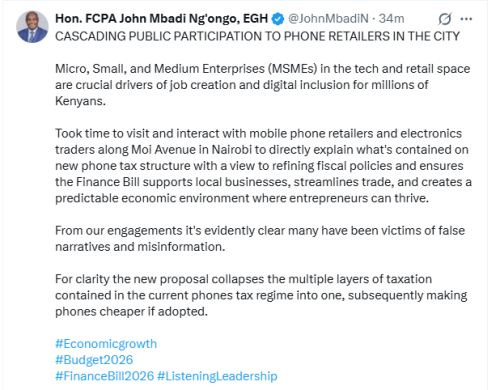
“Micro, Small, and Medium Enterprises (MSMEs) in the tech and retail space are crucial drivers of job creation and digital inclusion for millions of Kenyans,” Mbadi wrote.
“Took time to visit and interact with mobile phone retailers and electronics traders along Moi Avenue in Nairobi to directly explain what’s contained in the new phone tax structure with a view to refining fiscal policies and ensuring the Finance Bill supports local businesses, streamlines trade, and creates a predictable economic environment where entrepreneurs can thrive.”
Single tax structure
Mbadi explained that the proposed tax changes seek to merge several existing taxes imposed on mobile phones into a single tax structure, arguing that the move would eventually make phones cheaper for consumers if adopted.

He said the government intends to streamline trade, create a predictable business environment and support local entrepreneurs in the electronics sector.
According to Mbadi, many traders had fallen victim to misinformation and false narratives surrounding the Finance Bill proposals, leading to fears that the government intended to introduce additional taxes on mobile devices.
“From our engagements, it’s evidently clear that many have been victims of false narratives and misinformation. For clarity, the new proposal collapses the multiple layers of taxation contained in the current phone tax regime into one, subsequently making phones cheaper if adopted,” Mbadi said.
Mobile phone tax debate
Under the proposed changes, the multiple charges would be replaced by a single 25 per cent excise duty applied at the point of activation. VAT, Import Declaration Fee and Railway Development Levy would be removed for mobile phones under the new system.

The Treasury said the aim is to simplify administration and improve tax efficiency.
“The proposal was therefore primarily conceived as a tax simplification and rationalisation measure rather than the introduction of a new tax on digital access,” it said.
It also acknowledged the role of mobile phones in daily life, saying they are now central to communication, education, financial services and digital work.