Lee Kinyanjui announces Kenya’s plan to increase raw sugar imports
By Kenneth Mwenda, August 28, 2025Cabinet Secretary for Investment and Industry, Lee Kinyanjui, has stated that Kenya plans to increase raw sugar imports to address a critical shortage affecting the country’s industrial sugar supply.
Speaking during a tour of Kibos Sugar and Allied Companies in Kisumu on Thursday, August 28, 2025, Kinyanjui explained the urgency of the situation.
“We don’t have enough raw sugar to process industrial sugar,” he said. “And industrial sugar is processed for use in the pharmaceutical industry, for use in the food industry, in the alcoholic industry, and all that. So as a result of that, we have to import industrial sugar because we don’t have enough raw sugar.”
The CS noted that the government is exploring partial importation to keep key factories operational.
“We’ll be looking into how we can allow part importation of that raw sugar so that we can have some of the factories, including where we are today, where there’s an investment of over two billion for a factory that has not worked since 2016,” he said.
Kinyanjui added that the aim is to secure both domestic and industrial sugar supplies while encouraging local production.
“We hope that farmers within this region and in the country at large, in the near future, will be able to produce enough sugar for domestic consumption and industrial consumption,” he explained.
Farmers urged to act
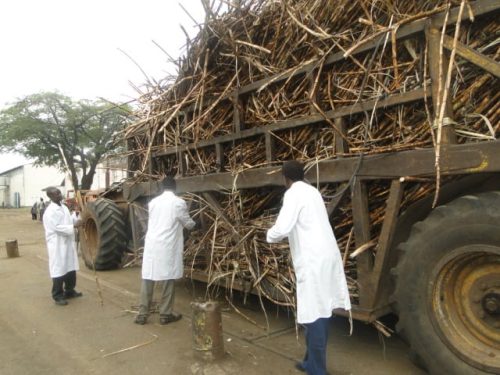
The government is also urging farmers to ramp up sugarcane production to address a growing shortage that threatens the operation of sugar mills across the country. Kinyanjui warned that several mills could shut down in the coming months if the supply of raw cane is not stabilised.
“We currently have a serious shortage of cane needed to sustain our sugar factories,” he said, highlighting vast tracts of idle land that could be used for sugarcane cultivation. He challenged both farmers and county governments to return to active farming, particularly as the government has restarted milling operations in various factories.
Kibos Sugar, which is preparing to launch its industrial-grade sugar line, is licensed to process 30,000 tonnes annually and has invested in infrastructure capable of handling up to 150,000 tonnes per year. However, the cane shortage is now affecting industrial production as well.
The CS also addressed concerns about locally produced packaging paper and warned against real estate developments encroaching on farmland.
“To protect our agricultural productivity, we need to move toward vertical development through the government’s affordable housing programme, instead of horizontal expansion that eats into farmland,” Kinyanjui said.
With a combination of strategic imports and renewed local production, the government hopes to stabilise Kenya’s industrial sugar supply, ensuring essential industries continue to operate.