Advertisement
Ksh stability boosts investor confidence amid global uncertainty
Saturday 27th September, 2025 01:48 PM|

The Kenyan shilling maintained its stability against major international and regional currencies during the week ending September 25, 2025.
The shilling exchanged at Ksh129.26 per U.S. dollar, up slightly from Ksh129.24 the previous week, according to the Central Bank of Kenya (CBK) Weekly Bulletin.
This performance comes as global economic pressures, including a strengthened U.S. Dollar Index by 1.2 per cent, continue to test emerging markets.
Also watch: Kakamega targets Ksh 2.2 billion increased revenue collection
You Might Also Like


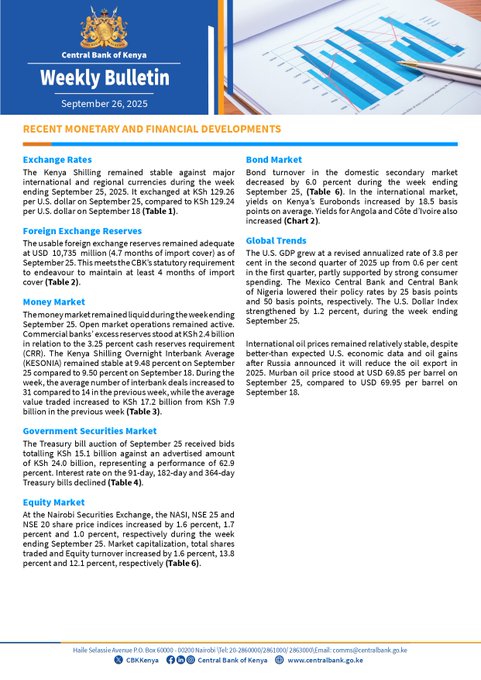
“The Kenyan shilling remained stable against major international and regional currencies during the week ending September 25, 2025. It exchanged at Ksh 129.26 per U.S. dollar on September 25, compared to Ksh 129.24 per U.S. dollar on September 18,” read the CBK report on X dated September 27, 2025.
The CBK reported usable foreign exchange reserves of Ksh 1,387,000 million, equivalent to 4.7 months of import cover, surpassing the statutory minimum of four months.
The bulletin noted that this level of reserves meets the requirement for the bank to maintain at least four months of import cover, reinforcing Kenya’s ability to handle external shocks.
“The usable foreign exchange reserves remained adequate at USD 10,735 million (4.7 months of import cover) as of September 25. This meets the CBK’s statutory requirement to endeavour to maintain at least 4 months of import cover.”
Signs of optimism
The Nairobi Securities Exchange (NSE) also reflected positive momentum. Market capitalisation rose by 1.6 per percent, while shares traded increased by 13.8 per cent over the review period, according to Table 6 of the CBK report. This activity indicates heightened domestic investor participation, coinciding with liquid money market conditions as commercial banks’ excess reserves stood at Ksh2.4 billion.
Interest rates on short-term government securities recorded mixed movements. The 91-day Treasury bill rate declined to 7.914 per cent, suggesting a moderation in yields during the period under review. Analysts have said such trends often signal improving confidence among investors in both the fixed income and equity segments of the market.
External risks
While the domestic indicators point to resilience, the CBK bulletin cautioned about rising international Eurobond yields, which increased by 18.5 basis points during the week. This development signals potential challenges for external borrowing costs.
“The money market remained liquid during the week ending September 25. Open market operations remained active. Commercial banks’ excess reserves stood at Ksh 2.4 billion in relation to the 3.25 per cent cash reserve requirement (CRR),” it added.
Nonetheless, the Bank’s proactive open market operations kept the interbank KESONIA rate steady at 9.48 per cent, ensuring liquidity remained stable. For businesses and households, a steady exchange rate provides a predictable environment for imports, exports, and pricing decisions, especially amid uncertainty in global markets.
“The Kenyan shilling Overnight Interbank Average (KESONIA) remained stable at 9.48 per cent on September 25 compared to 9.50 per cent on September 18. During the week, the average number of interbank deals increased to 31 compared to 14 in the previous week, while the average value traded increased to Ksh 17.2 billion from Ksh 7.9 billion in the previous week.”
The CBK reaffirmed its commitment to monitoring both domestic and external conditions to maintain market stability. The report suggests that Kenya’s current position, underpinned by robust reserves and steady monetary operations, provides a foundation for navigating potential headwinds in the months ahead.
Author
Latest News








Advertisement
More on Business