KRA seeks public feedback on new rental tax and graduate apprenticeship rules
By Ndiritu Wanjiru, May 6, 2026The Kenya Revenue Authority (KRA) has invited Kenyans to express their opinions on two new proposed tax regulations that aim at streamlining the income tax structure in Kenya and supporting young people in gaining employment.
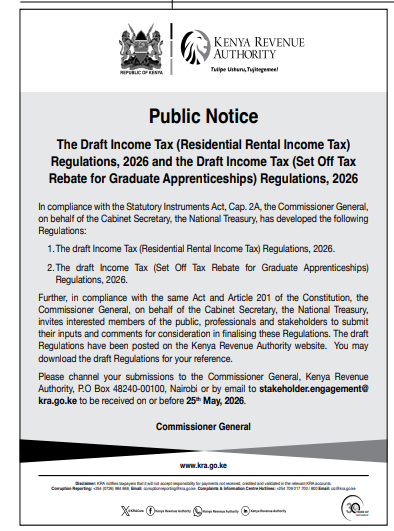
In a public notice published by the Commissioner General on MyGov on Tuesday, May 6, 2026, acting on behalf of the National Treasury, KRA announced the production of the Draft Income Tax (Set off Tax Rebate on Graduate Apprenticeships) Regulations, 2026, as well as the Draft Income Tax (Set off Tax Rebate on Graduate Apprenticeships). Regulations, 2026.
“In compliance with the Statutory Instruments Act, Cap. 2A, the Commissioner General, on behalf of the Cabinet Secretary, the National Treasury, has developed the following regulations: 1. The draft Income Tax (Residential Rental Income Tax) Regulations, 2026. 2. The draft Income Tax (Set off Tax Rebate for Graduate Apprenticeships) Regulations, 2026,” the KRA commissioner general’s notice read in part.
The KRA has noted that proposed rental income tax regulations on residential rent and taxation of rental property will be simplified and provide clearer guidelines for taxation of residential rent. This follows as the government still tries to increase compliance and increase the tax base in the expanding real estate market in Kenya.
Conversely, the regulations of the Graduate Apprenticeship Tax Rebate are aimed at incentivising employers to provide fresh graduates with apprenticeship opportunities by allowing tax rebates. It is perceived as a larger initiative to address youth unemployment by promoting the involvement of the private sector in skills training.
KRA has observed that the draft regulations’ development is in line with the Statutory Instruments Act and the Constitution of Kenya, which require participation by the people in the development of statutory instruments and the policies of public finance.
Call for public views
The authority has called upon the members of the public, professionals, and other stakeholders to consider the draft regulations, which are available on the KRA website, and provide their comments on the same, which should be taken into consideration before the rules are finalised.
The commissioner general may receive submissions by post or email, and submissions must be received by May 25, 2026.

KRA has further pointed out its disclaimer, warning taxpayers that it will not be liable to make payments which are not received, credited, or validated in its official accounts. The authority also urged the people to report corruption by using the reporting mechanisms that the authority had instituted.
The end result of this process of public participation is likely to influence final regulations, which may have a significant impact on landlords, employers, and young graduates entering the workforce.