KPA rejects cost escalation claims on Ksh8.3B Mombasa port road project
By Ndiritu Wanjiru, July 10, 2026The Kenya Ports Authority (KPA) is denying that the Ksh8.3 billion project for upgrading the Port of Mombasa is an over-cost road construction scheme.
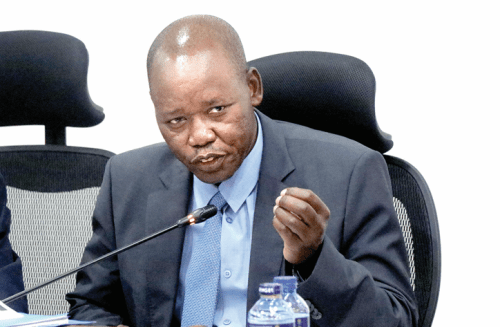
In a statement on Wednesday, July 8, 2026, KPA Managing Director Captain William Ruto noted that in the wake of the 2018 TradeMark Africa Traffic Management Study that identified the Back of Port Road as a key traffic choke point where a grade-separated transport solution is needed, the project has been given the green light.
“The project is not just a road. It is an infrastructure project that involved levelling the hill slope and the construction of a retention wall to prevent erosion. We floated an international tender where some bidders wanted to do the project for Ksh10 billion. We awarded it to the lowest bidder,” Ruto said.
The project is already 50 per cent finished and is part of its long-term programme of infrastructure modernisation, KPA said. It will, upon completion, enhance connectivity between Gates 18 and 20, Kipevu Road and the Northern Corridor, as well as cater to the increasing cargo volumes at the port.
Competitive tender process
The KPA director revealed that the project had been bid for by international contractors, the bids of which ranged from Ksh8.3 billion to Ksh9.6 billion.
Eventually, the contract was awarded to the Stecol Corporation and Miliki Development Company joint venture with the lowest evaluated responsive bid of Ksh 8.3 billion.
The project, he said, is within the market price, even cheaper, and gives value for money.
“It is within the market price, and I can even say it is cheaper. In terms of our consultant, it is even cheaper. We are getting value for money as KPA. The problem is only that we called it a road instead of calling it a major infrastructure project that we are building in the port,” Captain Ruto said.
He noted that the project should be finished in March next year.
Why is the structure different?
This development comprises a 1.8 km dual carriageway with 704 m of elevated viaduct, which is supported using bored pile foundations and reinforced concrete box girders.
The viaduct will be 15 metres tall above ground level to enable a continuous flow of heavy port traffic around existing critical infrastructure.
Project consultant engineer Stephen Wasike said the elevated design was required because of existing facilities within the port, like the live petroleum pipelines and the One-Stop Centre, which could not be relocated or demolished.
A viaduct is a bridge-like structure that is built over land with developments below, Wasike explained.
Safety considerations were factors around the petroleum pipeline and the importance of maintaining essential port functions, he added, which led to the elevated structure being the best engineering option.
Major supporting infrastructure
The project also contains two large roundabouts, ramps, slip roads and other traffic management infrastructure, providing for better cargo evacuation and minimising traffic conflicts within the port.
The engineers have been working on a large amount of earthworks, such as the excavation of Kipevu Hill (around 450,000 cubic metres of rock cutting and 150,000 cubic metres of engineered fill).
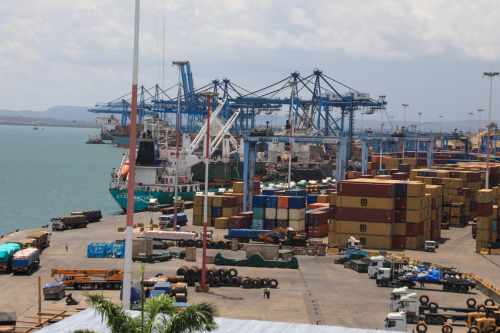
The project also calls for a 265-metre Geosynthetic Mechanically Stabilised Earth (GMSE) retaining wall to stabilise the excavated slope adjacent to Kenya Pipeline Company (KPC) petroleum storage facilities to protect them from the surrounding areas.
The works also include the relocation of vital utility services such as the port’s high-voltage power network, a purpose-built utility tunnel under Kipevu Hill, water mains, fibre-optic communication services, electrical services, and the integrated security system.
Additionally, contractors are building a large stormwater drainage tunnel that will run underground from the gantry workshop to the Kipevu outfall to safely divert stormwater, thus preserving the new transport facility and the port’s other facilities.