Kenya’s public debt nears ksh13T as Treasury shifts more borrowing to local market
By Aloys Michael, July 8, 2026Kenya’s public debt edged closer to the Ksh13 trillion mark at the end of April 2026, with the National Treasury increasingly turning to the domestic market to finance government operations even as the country’s external debt declined.
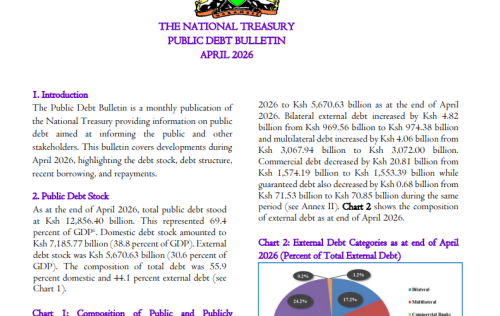
According to the National Treasury’s April 2026 Public Debt Bulletin, total public debt stood at Ksh12,856.40 billion, equivalent to 69.4 per cent of Gross Domestic Product (GDP). Of this, domestic debt accounted for Ksh7,185.77 billion, or 55.9 per cent of the total debt stock, while external debt stood at Ksh5,670.63 billion, representing 44.1 per cent.
The latest figures point to a growing reliance on domestic borrowing, with the Treasury raising more funds from the local market even as it reduced exposure to foreign loans.
The report notes that domestic debt stock increased by Ksh36.05 billion, rising from Ksh7,149.72 billion at the end of March to Ksh7,185.77 billion by the end of April. In contrast, external debt declined by Ksh12.59 billion, falling from Ksh5,683.22 billion to Ksh5,670.63 billion over the same period.
“The total external debt stock decreased on account of repayments and exchange rate movements by Ksh12.59 billion,” the Treasury said in the bulletin.
The report further states that domestic borrowing was driven by increased issuance of Treasury bonds, whose stock rose by Ksh81.30 billion during the month. Meanwhile, Treasury bill holdings declined by Ksh57.00 billion, reflecting the government’s continued preference for longer-term debt instruments that reduce refinancing risks.
Treasury also reported robust investor appetite for government securities. During April, it advertised Ksh156.00 billion worth of Treasury bills and bonds but received bids worth Ksh182.55 billion, eventually accepting Ksh149.48 billion.
The shift towards domestic borrowing comes as Kenya continues implementing debt management reforms aimed at reducing foreign exchange risks while deepening the local debt market.
Borrowing locally shields the government from exchange rate volatility that often inflates the cost of servicing foreign-denominated loans when the shilling weakens.

The Treasury noted that the decline in external debt was partly supported by favourable currency movements. During April, the Kenya shilling appreciated by 0.57 per cent against the US dollar and 1.02 per cent against the Japanese yen, helping lower the value of some foreign obligations.
However, economists have long cautioned that increased domestic borrowing can have unintended consequences for the wider economy. Heavy government demand for local funds may crowd out private sector borrowers by reducing the amount of credit available to businesses and households.
It can also exert upward pressure on interest rates, making borrowing more expensive for companies seeking to expand and for individuals financing investments.
Even so, the Treasury’s latest data suggests investors remain confident in government securities. Treasury bonds now account for 84 per cent of domestic debt, underscoring the government’s strategy of extending debt maturities to manage repayment risks more effectively.