Kenya’s foreign exchange reserves hold at 6-month import cover, CBK reports
By Faith Lagat, July 19, 2026Kenya’s foreign exchange reserves remained at a strong level of about Ksh1.83 trillion, equivalent to 6.0 months of import cover, as of July 16, 2026, according to the Central Bank of Kenya’s (CBK) latest Weekly Bulletin.
The reserves continue to exceed the statutory threshold that requires the CBK to maintain at least four months of import cover, providing a buffer against external shocks and supporting stability in the country’s foreign exchange market.
“The foreign exchange reserves remained adequate at USD 14,169 million (6.0 months of import cover) as of July 16. This meets CBK’s statutory requirement to endeavour to maintain at least 4 months of import cover,” the bulletin states.
The latest figures indicate continued strength in Kenya’s external position as the country enters the second half of the year.
Foreign exchange reserves increase
CBK data shows the country’s foreign exchange reserves have risen steadily over the past month.
The reserves stood at USD 13,149 million (about Ksh1.70 trillion), equivalent to 5.6 months of import cover, on June 18 before increasing slightly to Ksh1.70 trillion on June 25, 2026.
They then rose to USD 14,047 million (about Ksh1.82 trillion) on July 2, pushing import cover to 6.0 months, before climbing further to USD 14,127 million (about Ksh1.83 trillion) on July 9 and reaching USD 14,169 million (about Ksh1.83 trillion) by July 16, 2026.
The import cover is calculated using the 36-month average of imports of goods and non-factor services, providing an indication of the country’s capacity to finance imports during periods of external pressure.
Maintaining reserves above the statutory minimum gives the Central Bank flexibility in managing the foreign exchange market while supporting macroeconomic stability.
Kenya shilling remains stable
The Weekly Bulletin also reported that the Kenya shilling remained stable against major international and regional currencies during the week ending July 16, 2026.
“The Kenya Shilling remained stable against major international and regional currencies during the week ending July 16, 2026. It exchanged at Ksh129.34 per U.S. dollar on July 16, compared to Ksh129.22 on July 9,” the report states.
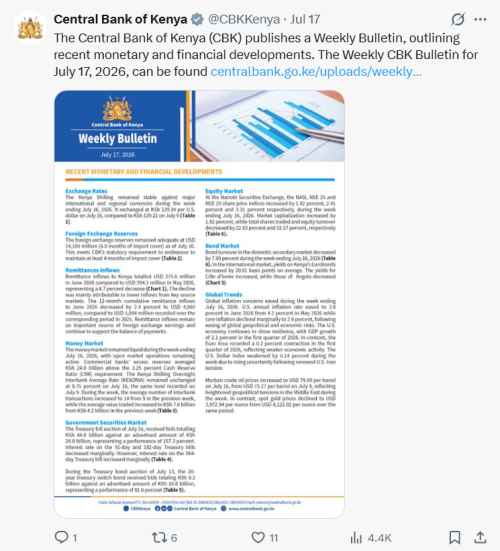
The weekly average exchange rate for the period between July 10, 2026, and July 16, 2026, stood at Ksh129.26 against the US dollar.
During the week, the shilling traded within a narrow range of Ksh129.19 to Ksh129.36 against the dollar.
The currency also remained stable against other major international currencies, including the Sterling Pound, Euro and Japanese Yen, as well as regional currencies such as the Uganda Shilling, Tanzania Shilling, Rwanda Franc and Burundi Franc.
Buffer against external shocks
The latest reserve position places Kenya well above the four-month import cover required under the Central Bank Act.
Foreign exchange reserves serve as a safeguard against external risks by supporting the country’s ability to meet import obligations and helping cushion the economy from volatility in global financial markets.
The steady growth in reserves over recent weeks, alongside a stable exchange rate, reflects continued monitoring of the country’s external position by the Central Bank.
According to the Weekly Bulletin, the reserves remain sufficient to support monetary and exchange rate stability while providing confidence in Kenya’s capacity to meet its external financing needs.