Kenya’s debt burden accelerates past Ksh13T mark
By Kenneth Mwenda, May 26, 2026Kenya’s public debt has crossed Ksh13 trillion for the first time. The figure is built from two official sources: the Central Bank of Kenya (CBK) and the National Treasury.
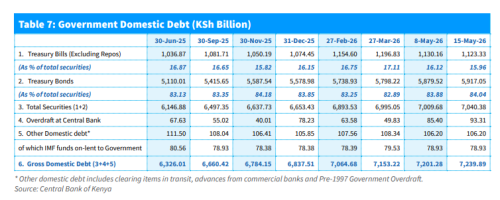
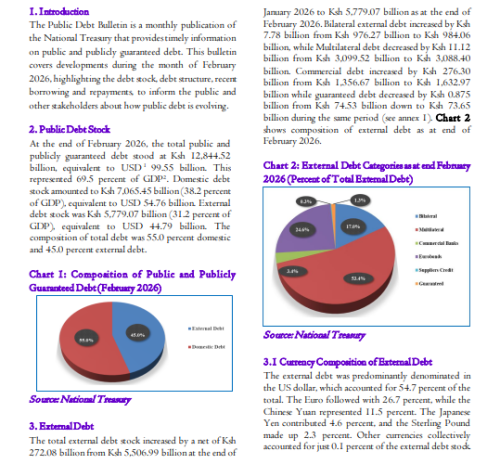
The CBK Weekly Bulletin for the week ending May 22, 2026 shows domestic debt at Ksh7.239 trillion as of May 15, 2026. The National Treasury Public Debt Bulletin for February 2026 shows external debt at Ksh5.779 trillion. When you combine the two, the total public debt reaches about Ksh13.02 trillion.
Domestic debt makes up the largest share of Kenya’s borrowing. At Ksh7.24 trillion, it is more than half of the total public debt.
Most of this money comes from Treasury bonds and bills sold to local banks, pension funds, insurance companies, and individuals. According to the CBK data, Treasury bonds alone account for over 80 per cent of domestic securities, while bills make up the rest.
Commercial banks hold the largest share of government domestic debt, at nearly 36 per cent. This means banks prefer lending to the government instead of private businesses. That affects credit in the wider economy.
When the government borrows heavily at home, it competes with businesses for the same pool of money. This pushes interest rates up and reduces lending to companies and households.
Debt has grown at a fast pace
Kenya’s debt has risen sharply over the past decade. The CBK records show the progression clearly:
- Ksh1 trillion in 2009
- Ksh5 trillion in 2018
- Ksh10 trillion in June 2023
- Ksh13 trillion in May 2026
The speed of growth has increased. This rapid rise has raised concern among economists and policymakers about sustainability.
The International Monetary Fund (IMF) projects Kenya’s debt-to-GDP ratio to reach 71.6 per cent in 2026, up from the current 69.5 per cent recorded in February 2026. This is well above the government’s legal target of 55 per cent of GDP by 2028 under the Public Finance Management framework.
Debt servicing is consuming public revenue
The most important pressure is not just the size of debt, but the cost of paying it.
In FY2024/25, the government spent about Ksh1.72 trillion on debt servicing. This is roughly 69 per cent of ordinary revenue, far above the IMF’s recommended threshold of about 30 per cent.
This means that for every Ksh 100 collected in taxes, almost Ksh70 goes to lenders.
Treasury Cabinet Secretary John Mbadi confirmed that this pressure will continue. Speaking on May 25, 2026, he said:
“Debt servicing alone takes about Ksh1.5 trillion.”
He warned that the budget is already heavily constrained:
“This budget is so rigid. It is inflexible. We have boxed ourselves.”
He added that the government has few options left:
“We have no option to come for more taxes. Borrowing is another no-go zone. So what is the other option left? Cut the budget.”

Why the budget is under strain
Kenya’s proposed 2026/27 budget is about Ksh4.82 trillion. Expected revenue is Ksh3.63 trillion, leaving a financing gap of about Ksh1.1 trillion.
But most of the spending is already fixed. After commitments, very little remains for development projects such as roads, hospitals, water systems, and job creation programmes.
This is why the government describes the budget as “rigid”.
Domestic borrowing is now a major driver of debt growth. The CBK shows that Treasury bonds and bills continue to rise each month.
When the government borrows more locally, it absorbs liquidity from banks and pension funds. This reduces the amount of money available for private lending.
As a result:
- Businesses face higher borrowing costs
- Small enterprises struggle to access credit
- Job creation slows
- Investment becomes more expensive
At the same time, households face higher loan rates on mortgages, personal loans, and business credit.
External debt adds currency pressure
External debt stands at Ksh5.78 trillion, or about 45 per cent of total debt. Most of it is denominated in US dollars and euros.
This creates a currency risk. When the shilling weakens, Kenya must spend more local currency to repay the same foreign loans.
Mbadi warned about this risk:
“We are praying and working hard that the shilling remains stable. If it depreciates, the cost of servicing debt goes up.”
This shows how exchange rate stability is now directly linked to fiscal pressure.
Citizens carry the burden
While debt figures are technical, the impact is direct.
Ordinary Kenyans feel it through:
- Higher taxes and new levies
- Lower take-home pay due to statutory deductions
- Slower job creation
- Underfunded hospitals and schools
- Delayed infrastructure projects
At the same time, inflation and the cost of living remain high, putting pressure on household budgets.
Many citizens see little improvement in services despite rising taxes. Instead, a large share of public revenue goes to interest payments.
Kenya is not in immediate default risk. But the fiscal space is shrinking.
Even Treasury acknowledges this. Mbadi admitted:
“We have come out of an almost very unfortunate situation of debt default, but we are not off the hook yet.”
This reflects a key challenge: Kenya is still borrowing to repay old debt while also funding new spending.
Without major changes in spending discipline, revenue growth, and economic expansion, debt will continue to dominate the budget.