Advertisement
Kenya lists market requirements as China’s zero-tariff policy comes into effect
Friday 01st May, 2026 03:44 PM|

Kenyan products are among those set to benefit from a new zero-tariff framework under the Kenya–China Early Harvest Agreement, allowing duty-free access to the Chinese market starting May 1, 2026.
The arrangement covers about 98.2 per cent of Kenyan exports and applies to countries in Africa with diplomatic ties with China. The policy is expected to expand market access and improve trade flows between the two economies.
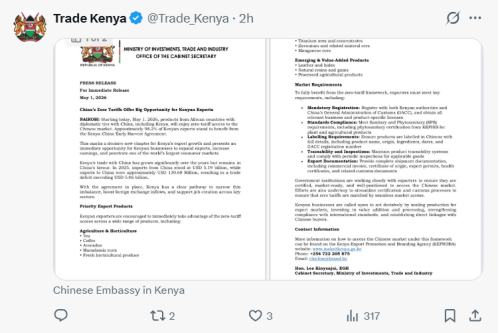
“Starting today, May 1, 2026, products from African countries with diplomatic ties with China, including Kenya, will enjoy zero-tariff access to the Chinese market. Approximately 98.2 per cent of Kenyan exports stand to benefit from the Kenya–China Early Harvest Agreement,” read the statement in part.
Trade expansion under new framework
Under the agreement, Kenyan exporters will now access the Chinese market without import duties on a wide range of goods. The initiative is part of broader efforts to strengthen economic cooperation and increase trade volumes.
You Might Also Like
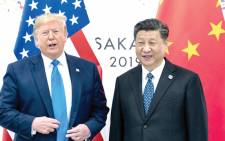


In 2025, Kenya imported goods worth approximately Ksh778.5 billion from China, while exports stood at about Ksh19.6 billion, resulting in a trade deficit of over Ksh758.9 billion. The zero-tariff policy is aimed at improving export competitiveness and supporting efforts to narrow the imbalance.
The framework is expected to create opportunities for increased foreign exchange earnings, job creation, and expansion of value-added production.
Key export categories
Agricultural and horticultural products are among the main beneficiaries, including tea, coffee, avocados, macadamia nuts, and fresh produce. Mineral exports such as titanium ores, zirconium, and manganese are also included under the duty-free arrangement.
Value-added goods like leather products, natural resins, gums, and processed agricultural items are expected to gain improved access to the Chinese market.
Exporters are encouraged to scale production and enhance compliance to take advantage of the new opportunity.
Compliance and market requirements
To benefit from the zero-tariff access, exporters are required to meet regulatory conditions set by both Kenyan authorities and China’s General Administration of Customs (GACC). These include mandatory registration, adherence to Sanitary and Phytosanitary standards, and certification from the Kenya Plant Health Inspectorate Service for agricultural products.
Other requirements include Chinese-language product labelling, traceability systems, and complete export documentation such as certificates of origin, commercial invoices, and health certificates.
Government agencies have indicated ongoing efforts to streamline certification and customs processes to support exporters in accessing the market efficiently.
The agreement is expected to remain in force until April 30, 2028, providing a defined period for expanded trade engagement and negotiation of further cooperation frameworks under broader Africa–China economic arrangements.
Author
Latest News








Advertisement
More on Business