Kenya importers face higher costs as Maersk raises freight charges from China
By Kenneth Mwenda, June 6, 2026Importers in Kenya are bracing for higher business costs after Danish shipping company Maersk increased freight charges on cargo from China and Hong Kong to East Africa. The new charges will affect shipments to Mombasa and Dar es Salaam starting mid-June 2026.
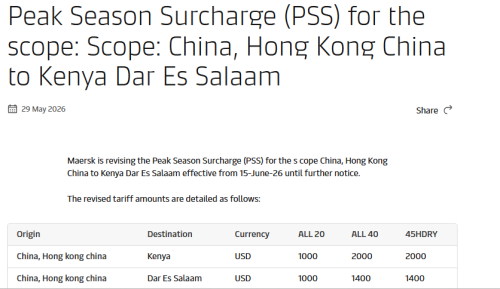
The change comes through a revised Peak Season Surcharge (PSS), which Maersk confirmed in an official notice on its website.
What Maersk announced
Maersk has introduced a new Peak Season Surcharge (PSS) on cargo moving from China and Hong Kong to Kenya and Tanzania. The changes take effect on June 15, 2026 and remain in place until further notice.
The company stated:
“Maersk is revising the Peak Season Surcharge (PSS) for the scope China, Hong Kong China to Kenya Dar Es Salaam effective from 15-June-26 until further notice.”
The surcharge applies mainly to non-spot bookings and is charged on top of normal freight and port fees. Here is a table of New Maersk freight surcharge rates:
| Route | Container type | New surcharge (Ksh) |
|---|---|---|
| China / Hong Kong → Kenya | 20ft | 130,000 |
| China / Hong Kong → Kenya | 40ft | 260,000 |
| China / Hong Kong → Kenya | 45ft HDRY | 260,000 |
| China / Hong Kong → Dar es Salaam | 20ft | 130,000 |
| China / Hong Kong → Dar es Salaam | 40ft | 182,000 |
| China / Hong Kong → Dar es Salaam | 45ft HDRY | 182,000 |
These figures come directly from Maersk’s official tariff notice.
For Kenyan importers, the 20-foot container now attracts an extra $1,000 (about Ksh130,000) in surcharge alone, before other logistics costs.
Why shipping costs are rising
Industry reports link the increase to ongoing pressure in global shipping routes.
Key factors include:
- Disruption in Red Sea and Middle East shipping lanes
- Congestion in major Asian ports
- Seasonal demand increases ahead of peak trade periods
- Higher operational costs for global shipping lines
The East African noted that shipping pressure is not limited to Kenya but affects wider East African trade routes.
How the surcharge affects Kenya’s economy
Kenya depends heavily on imports from China, which supplies:
- Electronics
- Machinery
- Construction materials
- Vehicles and spare parts
- Household goods
When freight costs rise, importers adjust prices at the wholesale level. These increases eventually reach retailers and consumers. The wave of freight rate increases is gathering momentum across global container shipping trades, driven by conflict disruptions and port congestion.
Shipping costs are a critical component of import pricing. Any increase feeds directly into retail prices across sectors.
Pressure on small importers and traders
Large importers may absorb part of the cost, but small and medium traders face immediate pressure.
A single container now carries thousands of shillings in additional charges, which affects:
- Stock replenishment cycles
- Profit margins
- Retail pricing decisions
Trade imbalance adds pressure
Kenya imported about $4 (Ksh516) billion worth of goods from China in 2025, according to trade data.
Exports to China remain much lower, creating a trade imbalance that increases Kenya’s sensitivity to import cost changes.
As a result, any increase in freight charges quickly affects the wider economy.
The Maersk Peak Season Surcharge increase adds new pressure on Kenya’s import sector at a time when global supply chains remain unstable.
While the change is driven by international shipping conditions, its impact is local and immediate. Importers face higher landed costs, and consumers are likely to feel price increases across essential goods.