Kenya Eurobond yields increase as global market sentiment shifts
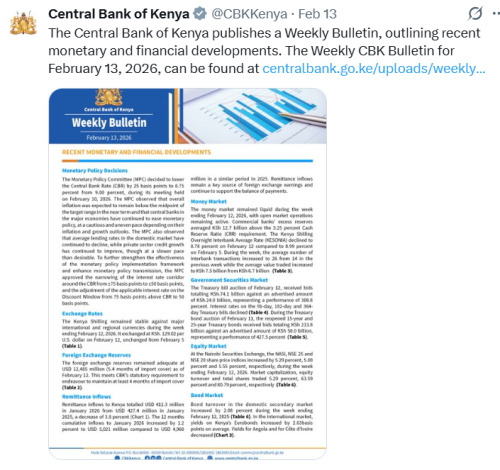
By Faith Lagat, February 15, 2026Yields on Kenya’s Eurobonds edged higher, increasing by an average of 2.63 basis points, as global market sentiment shifted in response to a strengthening US dollar and evolving interest rate expectations, the Central Bank of Kenya (CBK) reported in its Weekly Bulletin released on February 13, 2026.
The modest rise in Kenya’s Eurobond yields contrasted with declines in similar instruments from Angola and Côte d’Ivoire, highlighting mixed performance across African sovereign debt.
CBK data shows that yields on benchmark issues moved unevenly: the 6-year 2031 bond rose 5 basis points, the 13-year 2034 bond climbed 5 basis points, and the 30-year 2048 bond added 4 basis points, while shorter-dated papers recorded marginal dips.
“In the international market, yields on Kenya’s Eurobonds increased by 2.63 basis points on average. Yields for Angola and for Côte d’Ivoire decreased,” read the CBK bulletin in part.
Global market trends influence yields
Analysts attribute the uptick to broader international developments. The US Dollar Index strengthened during the week, reflecting resilient US labour market data, with unemployment falling to 4.3 per cent, and persistent expectations around Federal Reserve policy.
Easing inflation in China and modest UK growth added to cautious investor positioning in emerging-market debt. International oil prices remained stable, with Murban crude closing at approximately Ksh8,886. per barrel, providing no major disruptive pressure.
Domestic markets show resilience
Kenya’s financial markets remained robust amid the external shifts. The money market stayed liquid, with commercial banks holding excess reserves of Ksh12.7 billion above the 3.25 per cent Cash Reserve Ratio requirement.
The Kenya Shilling Overnight Interbank Average Rate (KESONIA) eased to 8.78 per cent on February 12, 2026, from 8.99 per cent the previous week, while interbank transaction volumes rose sharply.
Government securities continued to attract strong demand. The February 12, 2026, Treasury bill auction drew bids worth Ksh74.1 billion, against an advertised amount of Ksh24 billion, achieving a 308.8 per cent performance rate. Rates on all tenors declined marginally.
The reopened 15-year and 25-year Treasury bonds on February 11, 2026, recorded an oversubscription of 427.5 per cent, with bids totalling Ksh213.8 billion against Ksh50 billion on offer.
Equity markets also posted gains, with the NASI, NSE 25, and NSE 20 indices rising 5.29 per cent, 5.00 per cent, and 5.55 per cent, respectively. Equity turnover surged 63.59 per cent and shares traded jumped 80.79 per cent, signalling renewed investor confidence at the Nairobi Securities Exchange.
Foreign exchange reserves stood at Ksh1.61 trillion as of February 12, 2026, equivalent to 5.4 months of import cover, while the Kenyan shilling remained stable against major currencies.
The slight increase in Eurobond yields signals higher external borrowing costs, but strong domestic liquidity, oversubscribed government paper, and buoyant equities indicate Kenya’s financial system remains well-supported amid global headwinds.