Kenya Bankers Association urges Central Bank to hold lending rate at 8.75%
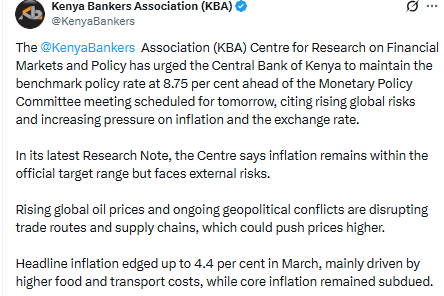
By Aloys Michael, April 7, 2026Commercial banks are lobbying the Central Bank of Kenya (CBK) to maintain its benchmark lending rate at 8.75 per cent, arguing that a cautious approach is necessary as global economic uncertainties intensify ahead of the Monetary Policy Committee (MPC) meeting scheduled for April 8, 2026.
In a statement on Tuesday, April 7, 2026, the Kenya Bankers Association (KBA) reflected growing concern within the financial sector that external shocks, ranging from geopolitical tensions to volatile commodity prices, could undermine the country’s fragile economic stability if monetary policy is adjusted prematurely.
“Exchange rate stability faces risks of a widening current account deficit and potential disruptions to diaspora remittances, arising from the protracted geopolitical conflicts. Sustaining the current monetary policy stance unchanged by keeping the policy rate unchanged at 8.75% would be ideal,” the KBA statement read.
The bankers’ position comes against a backdrop of slightly rising inflation. Data for March shows headline inflation ticking up to 4.4 per cent, largely driven by increases in food and transport costs, even as underlying price pressures remain relatively contained.
While Kenya’s post-pandemic recovery has largely held steady, there are signs that economic momentum is beginning to soften.
Private sector activity has slowed in recent months, with businesses and consumers adopting a more cautious stance amid uncertainty linked to ongoing conflicts in the Middle East and Eastern Europe.
The MPC has been easing monetary policy over the past year to support growth. In its last on February 10, 2026, the committee trimmed the Central Bank Rate by 25 basis points from 9.0 to 8.75 per cent, marking the tenth consecutive cut aimed at stimulating lending and boosting economic activity.
Although commercial banks responded by lowering lending rates, the transmission of these reductions has been uneven. Structural constraints within the financial system, alongside elevated credit risks, have limited how quickly cheaper credit reaches businesses and households.
Interest rates crisis
According to the KBA, private sector credit growth has shown signs of improvement but remains vulnerable. Banks are still grappling with high levels of non-performing loans, prompting a more cautious approach to lending despite the lower interest rate environment.
At the same time, pressure is building on the Kenyan shilling, which has weakened slightly to trade at around 130 units against the US dollar after a prolonged period of relative stability. Analysts attribute this to a widening trade deficit, as imports continue to outpace exports, alongside concerns about the sustainability of diaspora inflows.
Global developments are adding to the strain. Oil prices have surged sharply in recent months, with Murban crude rising from about Ksh8,200 per barrel in December 2025 to nearly Ksh 12,65 by late March 2026.
The increase, driven by supply chain disruptions and geopolitical tensions, is expected to feed into higher domestic costs.
Despite earlier gains in controlling inflation, these external pressures could reverse progress, posing a dual risk to both price and exchange rate stability.
Bankers warn that tightening policy too soon could further dampen credit growth, while loosening it could exacerbate inflationary and currency pressures.
In this delicate balance, the KBA argues that holding the policy rate steady offers the most prudent path.
By maintaining the current stance, the MPC would allow more time for earlier rate cuts to filter through the economy while safeguarding against emerging global risks that continue to cloud the outlook.