Inside govt’s Ksh8.1T Mrima Hill tender for global investors
By Aloys Michael, March 30, 2026The government, via the Ministry of Mining and Blue Economy, has launched a competitive bidding process for one of the globe’s most prized mineral reserves located at Mrima Hill in Kwale County.
The site, known for its exceptionally rich untapped minerals, now presents an opportunity for global powers, including the United States and China, to vie for mining rights.
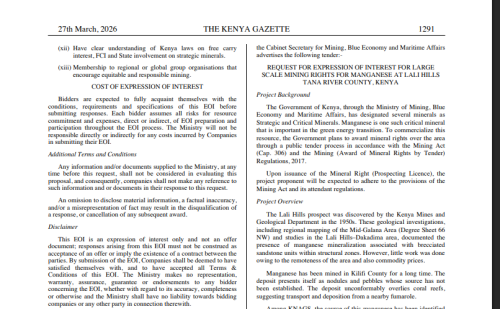
The Ministry issued a formal tender through a gazette notice on Friday, March 27, 2026, for Mrima Hill, inviting global companies to bid for rights to mine niobium and rare earth elements from a deposit valued at 64 billion USD, around Ksh8 trillion.
“In exercise of the powers conferred by sections 14 (1) and 223 (2)(e) of the Mining Act, Cap 306 and the 2017 Regulations, the Government of Kenya invites expressions of interest (EOI) from suitably qualified mining operators to commercialise the Mrima Hill mineral deposits,” the notice states.
“To commercialise these resources, the Government plans to award mineral rights over the area through a public tender process, as outlined in the Mining Act (Cap 306), and the Mining (Award of Mineral Rights by Tender) Regulations, 2017.”
The hill, located about 65 kilometres southwest of Mombasa, was first discovered by Kenyan geologists in the 1930s and later explored through a major joint campaign with Anglo American plc during the 1950s.
A 2022 geological survey at Mrima Hill confirmed the presence of five major minerals, including niobium, yttrium, thorium, strontium, and lanthanum, placing the site among the largest undeveloped mineral deposits in the world.
The survey indicated resources of 5.8 million tonnes of niobium and 48.7 million tonnes of rare earth elements, with inferred deposits reaching 110.7 million tonnes, marking Mrima Hill as a rare, high-value mineral discovery.
In January 2026, Cabinet Secretary Hassan Joho announced that the government would make open tendering of the site’s mineral rights mandatory, aiming to replace previous opaque licensing deals that limited Kenyan benefits.
This is the first time mineral rights of this magnitude are being awarded through competitive bidding, a move expected to revolutionise how Kenya manages its critical natural resources.

Niobium, a metal that enhances the strength of steel, is critical for jet engines, oil pipelines, and space infrastructure. Meanwhile, other rare-earth elements, such as yttrium, thorium, strontium, and lanthanum- play vital roles in smartphones, electric vehicle batteries, and advanced military guidance systems relied upon by global powers.
A U.S.-supported consortium, Mrima Earth Ltd, has submitted a value-added proposal to Kenya’s National Mining Corporation (NAMICO), pledging to carry out downstream processing within the country, create local employment, and provide long-term skills development, rather than simply exporting raw minerals.
China, which controls approximately 80 per cent of the world’s rare-earth processing capacity, is also competing for access via state-backed firms that have spent years cultivating strong diplomatic relations with the Kenyan government.
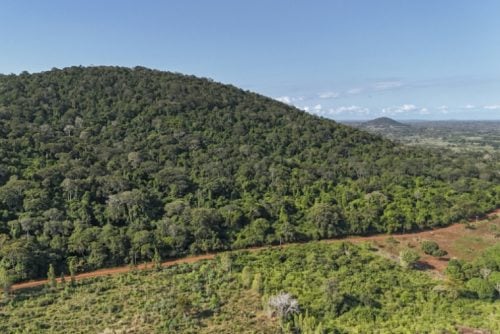
In late 2025, community guards at Mrima Hill were reported to have prevented Chinese nationals from entering the site without authorisation, highlighting the intense global competition for the resource.
In April 2025, Australian companies RareX and Iluka Resources submitted a joint application to develop the project in collaboration with NAMICO, proposing to process a portion of the minerals at Iluka’s existing refinery in Australia.
The project faces significant challenges because Mrima Hill is double-gazetted, classified both as a protected forest reserve and as a sacred Kaya forest for the Mijikenda and Digo communities along Kenya’s coast.
Residents have voiced concerns over displacement, radioactive waste from mining, and potential destruction of sacred shrines that carry profound spiritual significance for generations of Mijikenda and Digo families.