ICPAK to MPs: Don’t sacrifice long-term growth for short-term fiscal stability
By Sharon Atieno, May 22, 2026
The Institute of Certified Public Accountants of Kenya (ICPAK) has urged Members of Parliament to avoid prioritising short-term fiscal stabilisation at the expense of long-term economic growth as they scrutinise the Finance Bill 2026, warning that some proposals could weaken key productive sectors.
Appearing before the Departmental Committee on Financial and National Planning on Friday, May 22, 2026, the accountants’ body acknowledged that the Finance Bill contains fewer tax increases compared to previous cycles but cautioned that several measures risk undermining Kenya’s digital economy and manufacturing competitiveness.
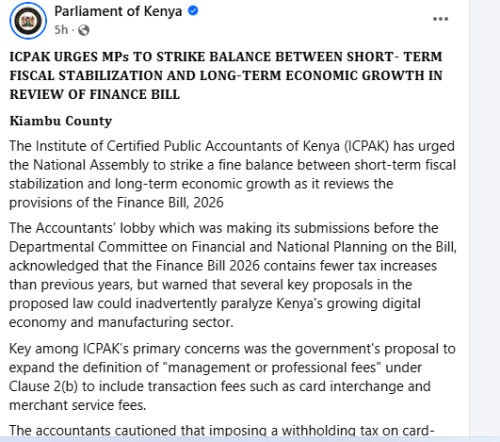
ICPAK raised concern over a proposal to expand the definition of “management or professional fees” to include transaction-related charges such as card interchange and merchant service fees.
“This will discourage the use of electronic and card-based payments, lead to an increased reliance on cash transactions, and fundamentally undermine Kenya’s digital economy and financial inclusion initiatives,” the institution warned.
The lobby also cautioned that extending withholding tax to software distribution could raise the cost of innovation and slow down digital transformation across businesses.
Digital economy and tax clarity concerns
ICPAK argued that international tax frameworks, including OECD guidelines, treat software licences as goods or business income rather than royalties, warning that misclassification could distort investment flows into Kenya’s tech sector.
The accountants further cautioned that unclear tax definitions could weaken Kenya’s positioning as a regional digital and financial hub.
Manufacturing sector under spotlight
ICPAK highlighted that Kenya’s manufacturing sector contributes 7.1 per cent of GDP and 11.7 per cent of formal employment, but warned of uneven performance, including a 24.8 per cent contraction in sugar production.
To boost industrial growth, the body proposed reducing import duties and lowering the Import Declaration Fee (IDF) and Railway Development Levy (RDL) to 1.5 per cent on industrial inputs.
However, Departmental Committee Chairperson Hon. Kuria Kimani cautioned against abuse of incentives.
“We have had complaints from yourselves as well as Kenya Association of Manufacturers that some unscrupulous traders have abused tax administration incentives extended to them by bringing in finished goods, while declaring them as raw materials,” Kimani said.
Calls for efficiency and fiscal discipline
Kesses MP Julius Rutto urged private sector players to improve efficiency to align with recent public finance reforms requiring timely submission of financial statements within three months after the financial year ends.
ICPAK also raised concern over Kenya’s rising public debt, which stood at Ksh 11,814.5 billion as of June 2025 representing 67.8 per cent of GDP warning that fiscal pressures remain significant despite consolidation efforts.

The institution praised Kenya Revenue Authority’s improved performance, including surpassing the Ksh 2 trillion revenue mark, but called for stronger public participation tracking mechanisms to enhance transparency in the budget-making process.
Committee Chair Kimani Kuria assured that all submissions will be considered to ensure the Finance Bill strikes a balance between revenue mobilisation and sustainable economic growth.