Govt gives SACCOs tight ultimatum to submit audited accounts
By Aloys Michael, January 9, 2026The government has directed all Savings and Credit Cooperative Organisations (SACCOs) to submit their audited financial statements by March 15, 2026.
In a notice issued on Friday, January 9, 2026, the SACCO Societies Regulatory Authority (SASRA) announced that the submission window runs from January 1 to March 15, 2026, in line with Section 41 of the SACCO Societies Act.
“Notice is hereby issued to all SACCO boards, supervisory committees, management and auditors to submit audited financial statements,” SASRA directed in an X notice.
“All Regulated SACCOS are required to submit their audited financial statements to the Authority in compliance with Section 41 of the SACCO Societies Act.”
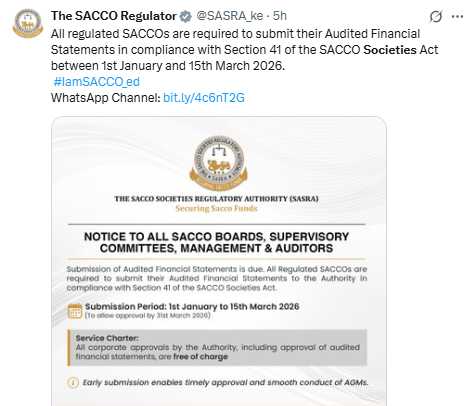
According to the regulator, the deadline is designed to allow sufficient time for review and approval of the audited accounts by March 31, 2026, ahead of the SACCOs’ Annual General Meetings.
“Submission Period is from January to March 15, 2026, to allow approval by March 31, 2026. Early submission enables timely approval and smooth conduct of AGMs,” SASRA stated.
The authority also clarified that, under its rules, all approvals, including approval of audited financial statements, are offered free of charge, dismissing concerns over regulatory fees.
SASRA urged licensed SACCOs to make the submissions early to avoid last-minute delays, reiterating its commitment to supporting the growth of all SACCOs.

It encouraged stakeholders to seek clarification through its official communication channels.
Under the Constitution, SACCOs are required to submit their audited financial statements to the regulator to ensure the safety of members’ deposits and the SACCO’s stability.
Why the audit reports
Audit reports verify that members’ savings are accurately documented and confirm the financial stability of the Cooperative society, while also addressing any cases of fund misappropriation.
If a SACCO does not submit its audited financial statements within the prescribed timeframe, it is deemed non-compliant by the government and may face penalties in accordance with the SACCOs Act.
Regular audits also help build trust among members and stakeholders, demonstrating transparency and accountability in the society’s financial management as the government pushes for reforms to provide an opportunity to identify inefficiencies and recommend improvements that strengthen the SACCO’s operations.
Moreover, timely submission of audited reports ensures that the SACCO remains eligible for regulatory benefits, including government support and access to credit facilities.
Non-compliance, on the other hand, can damage the society’s reputation and reduce members’ confidence in its governance.