EPRA fuel review: How Strait of Hormuz closure could push Kenya’s prices higher in the coming months
By Kenneth Mwenda, July 16, 2026Kenya’s latest EPRA fuel review brought relief to motorists after the Energy and Petroleum Regulatory Authority (EPRA) left pump prices unchanged for the period between July 15 and August 14, 2026. Super petrol remains at Ksh214.03 per litre in Nairobi, diesel at Ksh222.86, and kerosene at Ksh191.38.
The decision came despite growing fears over renewed conflict in the Middle East, where tensions between the United States and Iran have once again placed the Strait of Hormuz at the centre of global energy markets.
While the government’s latest interventions have prevented an immediate increase in pump prices, energy experts warn that a prolonged disruption or closure of the strategic waterway could place significant upward pressure on future EPRA fuel prices in Kenya.
The latest EPRA fuel review today reflected lower international landed costs for petroleum products imported into Kenya.
According to EPRA, the average landed cost of super petrol declined by 21 per cent in June to $886.92 (Ksh115,070) per metric tonne, while diesel fell by 19.8 per cent to $984.37 (Ksh127,700) per metric tonne. Kerosene also dropped by 11.7 per cent to $1,028.17 (Ksh133,370) per metric tonne.
The Kenya shilling also remained relatively stable, with EPRA using an exchange rate of about Ksh129.72 against the US dollar during the pricing period.
Ordinarily, falling landed costs would create room for lower pump prices. Instead, the government chose to maintain current prices through additional support measures.
Energy Cabinet Secretary Opiyo Wandayi announced that the government had extended the 8 per cent VAT on petroleum products until October 14, 2026, and approved a Ksh945 million subsidy from the Petroleum Development Levy.
“As part of the government’s commitment to cushioning households and businesses from international market volatility, we have extended the application period for 8 per cent VAT on petroleum products for a further three months,” Wandayi said.
He added that the subsidy would help “sustain the current price levels” during the July-August pricing cycle.
Those measures have delayed the impact of rising global uncertainty, but they may not be enough if international oil prices continue climbing.

Why the Strait of Hormuz matters
The Strait of Hormuz is one of the world’s most important energy corridors.
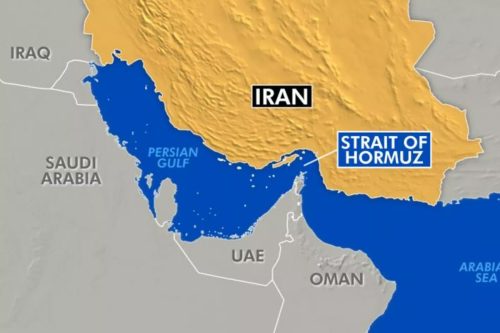
Located between Iran and Oman, it connects the Persian Gulf to the Gulf of Oman and the Arabian Sea.
Around 20 million barrels of crude oil and petroleum products pass through the strait every day. That represents roughly one-fifth of global oil consumption and nearly a quarter of all seaborne oil trade.
The northern side of the waterway lies along Iran’s coastline, giving Tehran significant influence over shipping movements.
Although Iran does not completely control the shipping lane, its military presence means it can threaten commercial vessels or temporarily disrupt traffic during periods of conflict.
The latest concerns follow renewed fighting between the United States and Iran.
The US military launched fresh strikes targeting Iranian coastal defence systems, missile launch sites and military facilities around Bandar Abbas and Greater Tunb Island, saying the attacks were intended to reduce Iran’s ability to threaten commercial shipping in the Strait of Hormuz.
US President Donald Trump warned Tehran that it had “better behave” as Washington continued military operations in the region.
Iran responded by warning that it could shut additional oil export routes while insisting that maintaining its own security arrangements in the Strait of Hormuz remained essential.
Although the strait has not been completely closed, tanker traffic has slowed significantly as security risks increase and insurers raise premiums for ships entering the region.
How a Strait of Hormuz closure affects fuel prices
A complete closure would have immediate consequences for global energy markets.
Oil exporters such as Saudi Arabia, Iraq, Kuwait, Qatar and the United Arab Emirates depend heavily on the route to ship crude oil to customers around the world.
If millions of barrels of oil cannot reach international markets, supply falls while demand remains relatively unchanged.
When supply tightens, crude oil prices usually rise.
Higher crude prices then increase the cost of refined petroleum products such as petrol, diesel and aviation fuel.
Shipping costs also rise because vessels must pay higher insurance premiums or take longer alternative routes where possible.
These additional costs eventually filter through to countries that import fuel, including Kenya.
In their July 15 analysis, economists Jean-Marc Natal and Azim Sadikov said the global oil market avoided a sharper price spike despite the effective closure of the Strait of Hormuz, which disrupted about 20 million barrels of crude oil and refined products a day – roughly a fifth of global consumption.
They said producers found limited alternatives, with Saudi Arabia rerouting exports through its Red Sea port of Yanbu – a key Saudi Aramco export terminal that also supplies Kenya under the Government-to-Government (G2G) fuel deal – while the United Arab Emirates maximised shipments through Fujairah, outside the strait.
However, these routes replaced only a fraction of the lost volumes. The analysts said the market was further supported by lower fuel demand, especially in Asia, increased oil production from the United States, Guyana, Venezuela, and Russia, and the release of commercial and strategic oil inventories.
They warned that those buffers are now shrinking, meaning any prolonged disruption could lift global oil prices more sharply and eventually put upward pressure on future EPRA fuel reviews in Kenya.
Kenya imports almost all its petroleum products.
Although the country benefits from the Government-to-Government (G2G) fuel import arrangement, local fuel prices still depend heavily on international markets.
Wandayi acknowledged that reality while announcing the government’s latest interventions.
“The market remains unsettled, and the Strait of Hormuz remains constrained, with commercial traffic running well below its usual levels,” he said.
He added: “With the restart of the Middle East crisis, international benchmarks have now begun to climb again, and this renewed pressure will be reflected in the pricing cycles that follow.”
Those remarks suggest future EPRA fuel review announcements could become more difficult if international prices continue rising.
Why Kenya has not experienced shortages
Despite the conflict, Kenya has continued to receive fuel cargoes.
According to Wandayi, every scheduled shipment has arrived and been discharged on time.
He attributed this to the Government-to-Government fuel import arrangement, which fixes freight charges and premium costs instead of exposing Kenya to volatile spot market prices.
“Kenya has continued to pay the same fixed freight and premium. That fixed cost, held constant while benchmark prices swing, is what has kept our landed costs in check and our deliveries on schedule,” he said.
The arrangement has also allowed suppliers to source fuel from alternative loading points outside the Gulf whenever necessary.
This flexibility has helped maintain fuel supplies even as geopolitical tensions intensify.
Why prices could still rise
Stable supply does not always mean stable prices.
The Government-to-Government arrangement protects Kenya from some shipping costs, but it cannot fully shield the country from sustained increases in global oil prices.
International energy analysts say the market has already used many of the buffers that helped absorb earlier disruptions.
Higher production outside the Gulf, weaker global demand and large oil inventories initially prevented prices from rising sharply.
However, many of those запасы have fallen, while spare production capacity has also narrowed.
If the Strait of Hormuz remains disrupted for several weeks or months, global benchmark prices could increase more sharply than before.
That would raise Kenya’s landed fuel costs and place pressure on future EPRA fuel prices and subsequent monthly reviews.
For now, Kenyan motorists have received temporary relief.
The latest EPRA fuel prices in Kenya remain unchanged because of lower landed costs, government subsidies and the extended 8 per cent VAT.
However, the next pricing review will depend largely on developments in the Middle East.
If commercial shipping through the Strait of Hormuz returns to normal, international oil prices could stabilise, easing pressure on Kenya’s fuel market.
If hostilities escalate or the waterway faces prolonged disruption, higher landed costs are likely to feed into future fuel prices in Kenya, increasing transport costs, production expenses and ultimately the cost of living.
For businesses, farmers, manufacturers and public transport operators, the EPRA fuel review over the coming months may depend less on local policy decisions and more on events unfolding thousands of kilometres away in one of the world’s most strategically important shipping lanes.