EPRA adds fresh levies on KenGen and IPPs as power bills rise again
By Kenneth Mwenda, May 17, 2026The Energy and Petroleum Regulatory Authority (EPRA) has issued detailed tariff adjustments that will push up electricity costs for May 2026, citing fuel costs, foreign exchange losses, and hydropower levies.
In a Gazette Notice dated May 15, 2026, EPRA confirmed three main charges: a fuel energy cost charge, a foreign exchange fluctuation adjustment, and a Water Resource Management Authority (WRMA) levy. The changes will apply to all meter readings taken in May.
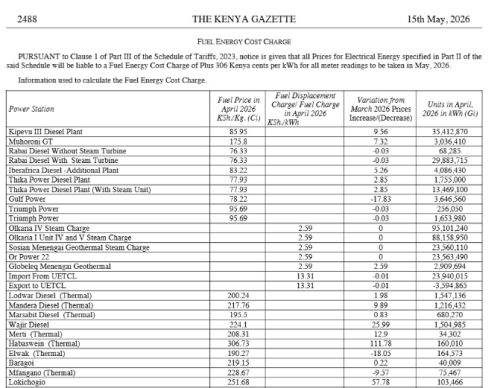
The Fuel Energy Cost Charge has been set at plus 306 Kenya cents per kilowatt-hour. EPRA said this applies under Clause 1 of Part III of the Schedule of Tariffs, 2023.
“PURSUANT to Clause 1 of Part III of the Schedule of Tariffs, 2023, notice is given that all prices for electrical energy specified in Part II of the said schedule will be liable to a fuel energy cost charge of plus 306 Kenya cents per kWh for all meter readings to be taken in May, 2026,” the notice reads.
This charge mainly reflects the cost of running diesel and thermal plants that support the grid when cheaper sources such as hydro and geothermal are not available. It includes stations like Kipevu III, Rabai, Iberafrica, Thika Power, and several off-grid diesel plants in northern Kenya.
EPRA also introduced a Foreign Exchange Fluctuation Adjustment of 110.33 cents per kWh. The authority said the adjustment comes from exchange rate losses recorded by electricity producers and distributors.
According to the gazette notice, total forex losses stood at Ksh1.17 billion in April 2026. These losses were recorded by KenGen, Kenya Power, and Independent Power Producers (IPPs), all of whom rely on foreign currency for fuel, equipment, and loan repayments.
The losses were calculated against 1.275 billion kilowatt hours of electricity generated and purchased in April, excluding exports.
Hydro levy, fuel costs
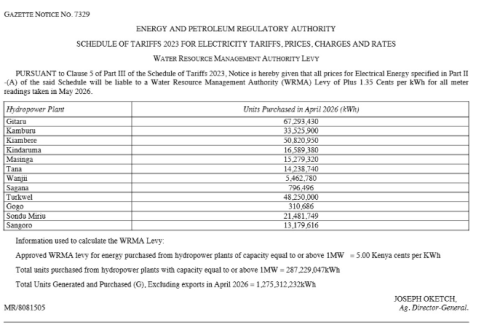
A third charge is the WRMA levy set at 1.35 cents per kWh. It applies only to electricity generated from major hydropower stations under the Seven Forks scheme and other large dams such as Gitaru, Masinga, Kiambere, Kindaruma, Turkwel, Sondu Miriu, and Sangoro.
EPRA said hydropower plants supplied 287.2 million kWh in April, meaning the levy applies only to that portion of supply. The funds go to the Water Resources Management Authority.
The authority noted that fuel costs remain a key driver of electricity prices, especially in off-grid regions that depend on diesel plants. Stations in Mandera, Wajir, Garissa, Turkana, Marsabit, and Lamu recorded some of the highest generation costs due to fuel transport and limited infrastructure.
EPRA said the adjustments reflect actual market conditions and monthly cost changes in generation. It also noted that similar charges were introduced in April 2026, when the fuel charge reached 347 cents per kWh and the forex adjustment stood at 123.41 cents per kWh.
The regulator maintained that the repeated revisions are necessary to match tariffs with real production costs and currency movements.
The latest changes mean households and businesses will continue paying separate charges for energy, fuel use, forex losses, and water levies on top of the base tariff, pushing May bills higher once again.