Advertisement
Dangote advances giant Ethiopian fertiliser plant as Nigerian billionaire eyes broader East Africa push
Sunday 17th May, 2026 04:08 PM|
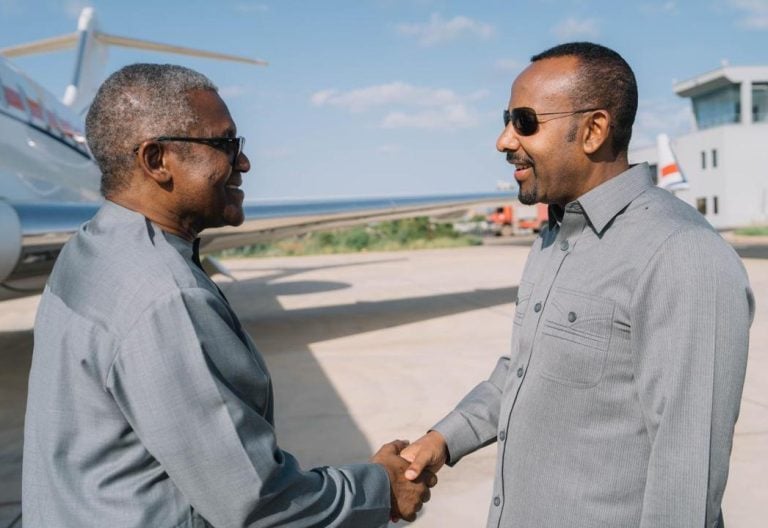
Nigerian billionaire Aliko Dangote is stepping deeper into East Africa through a major industrial push in Ethiopia, even as his wider energy plans shift away from Tanzania and lean towards Kenya.
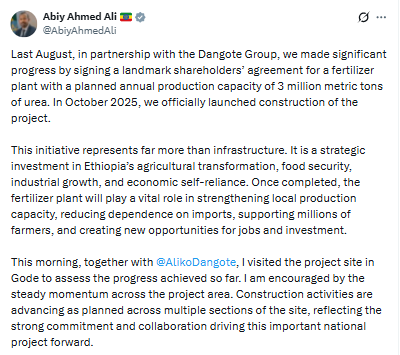
In Ethiopia, Dangote joined Prime Minister Abiy Ahmed Ali on May 17, 2026, at the Gode site in the Somali region to inspect construction of a Ksh323 ($2.5) billion fertiliser plant. The project will produce 3 million metric tonnes of urea a year once completed in 2029.
Dangote Group holds 60 per cent of the venture, while Ethiopian Investment Holdings holds 40 per cent. The partners signed the shareholders’ agreement in August 2025 and started construction in October. In March 2026, they secured a Ksh543 ($4.2) billion gas supply deal with China’s GCL Group to feed the plant from the Calub fields.
Abiy said the project targets more than infrastructure. “It is a strategic investment in Ethiopia’s agricultural transformation, food security, industrial growth, and economic self-reliance,” he said after the visit. He added that construction is advancing across multiple sections of the site and remains on schedule.
You Might Also Like

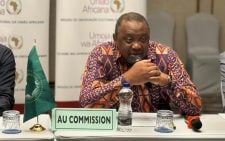
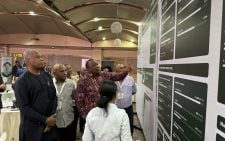
Dangote also linked the project to Africa’s wider needs. He said the gas-to-fertiliser chain shows how the continent can reduce reliance on imports. He added that Ethiopia and Nigeria would be the only sub-Saharan African countries producing urea at this scale.
The Gode plant fits into his broader East African strategy. Dangote plans about 20 fertiliser blending plants across Africa by 2028. The Ethiopian facility will supply local demand and serve neighbouring markets, cutting the region’s heavy fertiliser import bill.
Kenya gains refinery edge
At the same time, his attention in the energy sector is shifting. He has expressed interest in a $15–17 billion oil refinery for East Africa, with a capacity of 650,000 barrels per day. He now prefers Kenya over Tanzania.
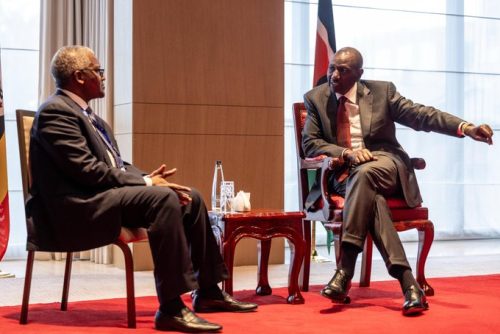
“I’m leaning more towards Mombasa because Mombasa has a much larger, deeper port. Kenyans consume more. It’s a bigger economy,” Dangote said in a Financial Times interview.
Technical assessments also placed Kenya ahead of Tanzania and Mozambique based on port depth, crude access, and market size.
This marks a setback for Tanzania, which had earlier been discussed as a potential site for a regional refinery at Tanga port. Kenyan President William Ruto had raised the idea of a joint East African refinery in April 2026, with Dangote attending the talks. He said he would lead the project if governments agreed on a framework.
The shift has also stirred diplomatic activity. Tanzanian President Samia Suluhu Hassan recently met Dangote in Dar es Salaam, where she highlighted his cement investment in Mtwara and its role in jobs and local trade. The talks reflected ongoing competition between East African states to attract large-scale industrial capital.
Dangote’s approach follows a consistent pattern. He builds around control of raw materials, large-scale production, and import substitution. In Ethiopia, he taps natural gas. In Kenya, he would process imported crude and supply regional fuel markets.
Ethiopia has reformed its investment rules to attract such projects. Dangote has praised those changes, calling the country one of Africa’s most attractive investment destinations.
Farmers in Ethiopia currently rely heavily on imported fertiliser, while East African economies spend billions on fuel imports. The Gode plant and the proposed refinery both aim to reduce foreign currency outflows and build local industrial capacity.
Author
Kenneth Mwenda
Kenneth Mwenda is a digital writer with over five years of experience. He graduated in February 2022 with a Bachelor of Commerce in Finance from The Co-operative University of Kenya. He has written news and feature stories for platforms such as Construction Review Online, Sports Brief, Briefly News, and Criptonizando. In 2023, he completed a course in Digital Investigation Techniques with AFP. He joined People Daily in May 2025. For inquiries, he can be reached at [email protected].
View all posts by Kenneth MwendaLatest News






Advertisement
More on Business