CS Mbadi outlines efforts to improve Kenya’s credit ratings
By Kenneth Mwenda, October 6, 2025National Treasury Cabinet Secretary John Mbadi has said Kenya’s efforts to strengthen debt management and financial discipline will help improve its credit ratings.
Speaking during the Credit Rating Workshop in Mombasa, on Monday, October 6, 2025, Mbadi said that credit ratings are key to how Kenya borrows and attracts investors. He explained that a good rating helps the country access cheaper loans and build trust among investors.
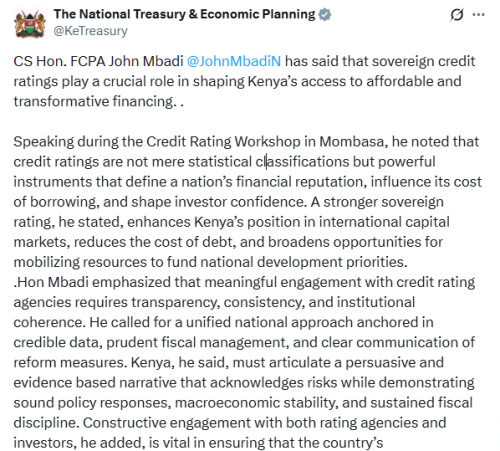
“Speaking during the Credit Rating Workshop in Mombasa, he noted that credit ratings are not mere statistical classifications but powerful instruments that define a nation’s financial reputation, influence its cost of borrowing, and shape investor confidence,” The National Treasury and Economic Planning posted.
“A stronger sovereign rating, he stated, enhances Kenya’s position in international capital markets, reduces the cost of debt, and broadens opportunities for mobilising resources to fund national development priorities.”
He also said that Kenya must engage openly with credit rating agencies, share accurate data, and maintain clear communication about reforms.
“Meaningful engagement with credit rating agencies requires transparency, consistency, and institutional coherence.”
To strengthen this process, the government will form a Credit Rating Committee to handle Kenya’s interactions with international rating agencies. The committee will ensure that Kenya’s ratings reflect its true economic performance and align with national goals.
Mbadi said the move will also help the government build its own technical capacity and avoid overreliance on external consultants.
Reforms boost fiscal stability
Mbadi noted that Kenya’s current credit ratings, B, B-, and Caa1 (Negative) by S&P, Fitch, and Moody’s, have made borrowing more expensive due to perceived risks. However, he welcomed the recent improvement in Kenya’s outlook, saying it resulted from reforms in the Finance Act 2025, which boosted tax compliance and fiscal credibility.
That said, the Treasury has raised Ksh193.8 billion (USD1.5 billion) to settle part of the 2028 Eurobond ahead of schedule. The government paid in tranches to ease future repayment pressure and stabilise the shilling.
“That is easier as opposed to waiting for a 1 billion US dollar bond and paying it once. It puts a strain on the economy,” he reiterated. Mbadi said earlier in a TV interview on Saturday, October 4, 2025.
The Eurobond deal, structured into seven- and twelve-year tranches, came at an effective interest rate of 8.7 per cent, which is one point lower than what Kenya would have paid earlier in the year.
Mbadi said such actions reflect the government’s commitment to managing debt wisely, avoiding default risks, and ensuring stability.
He concluded that better credit ratings will not only lower borrowing costs but also free up money for key sectors such as health, education, and infrastructure.