CS Mbadi moves to calm fears over Safaricom sale, vows productive use of proceeds
By Faith Lagat, December 5, 2025Treasury Cabinet Secretary John Mbadi has moved to allay public concerns over the government’s sale of a 15 percent stake in Safaricom to Vodafone for USD 1.56 billion (Ksh204 billion) plus a Ksh40.2 billion dividend advance, totalling Ksh 244 billion.
Speaking in an interview on December 4, 2025, Mbadi described the transaction as a strategic step to unlock value from what he termed a mature investment rather than a distressed sell-off.
“First of all, I want to make it very clear that what we are doing is what we call unlocking value for a mature investment. The Safaricom PLC, as an investment for the Republic of Kenya as it is today is a mature investment and that is what you can unlock,” Mbadi said.
Safaricom proceeds to seed infrastructure fund
Mbadi dismissed fears that the funds would be channelled into recurrent spending or budget support, insisting that the money will be diverted into long-term development.
“Now depending on where you invest this money because I think the fear maybe Kenyans have here is that we are divesting in Safaricom 15 percent, getting this money and consuming it or putting it in budgetary support. That is not what we intend to do,” he said.

“What we intend to do is to productively use the resources that we are going to raise by divesting 15 percent in Safaricom and any other privatisation, put it in a national infrastructure fund which then we would use to link the private sector and institutional investors with public investment or public infrastructure.”
Mbadi said Kenya’s fiscal space is constrained, with limited choices for funding large-scale development projects.
“Presently you can do it in two ways. One is taxation, the other one is debts. Now taxation, putting more or hiking taxes is not an option. Going to more debts is not an option yet we have huge investment projects that we need to put money in,” he noted.
Infrastructure, energy and trade hurdles
The CS argued that sustained economic growth requires massive investment in connectivity and energy.
“Analysis and studies have shown that for Kenya to create employment opportunities that would match the number of the youth who come out of colleges to join the labor market, we need at least seven percent economic growth. How are we going to realize economic growth without further investment in infrastructure projects like roads?” he posed.
He added that poor transport links to Uganda and Tanzania, alongside unreliable rain-fed agriculture and high electricity costs, continue to suppress investment.
Majority control intact
Mbadi insisted that government revenue from Safaricom remains significant even after divestiture.
“It is not that the government of Kenya will now forego the 16 or 18 billion. We will still get almost about 10 billion every year if we continue with the current rates of performance… What you forego is probably about seven billion per year.”
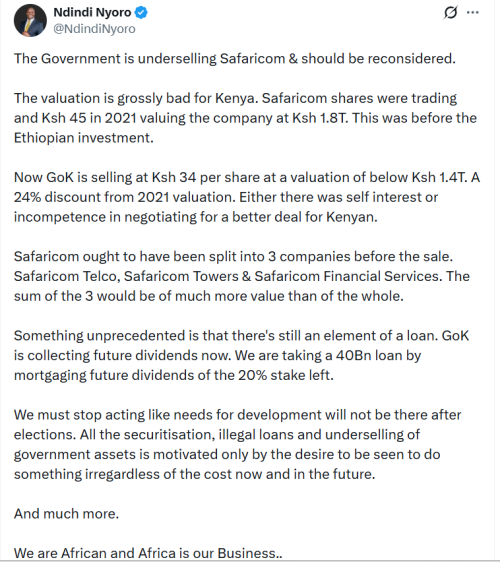
The transaction has drawn criticism from Kiharu MP Ndindi Nyoro, who argues that pricing the shares at Ksh34 undervalues the telecom giant.
Despite the pushback, Mbadi maintains that “this is probably the right time to divest,” citing technological shifts and regional expansion needs.
The Ksh244 billion raised will capitalise the National Infrastructure Fund and Sovereign Wealth Fund, with the government retaining majority control of Safaricom.