Advertisement
CS Chirchir details how incentives will drive electric vehicles uptake
Tuesday 03rd February, 2026 08:10 PM|

Transport Cabinet Secretary Davis Chirchir has announced the government’s move to introduce targeted incentives covering the electric mobility policy.
Speaking after the launch of Kenya’s National Electric Mobility Policy on Tuesday, February 3, 2026, Chirchir described the policy as a major milestone in the transition to a cleaner, more resilient transport system in Kenya.
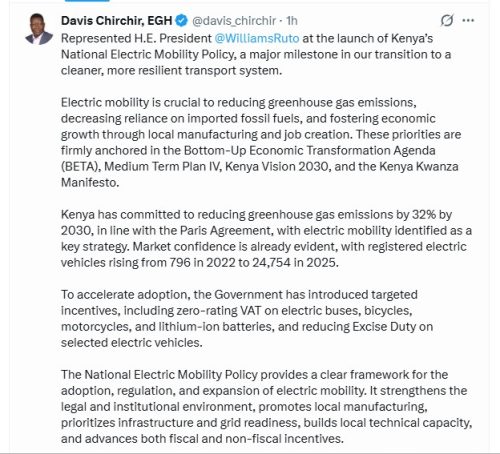
“Electric mobility is crucial to reducing greenhouse gas emissions, decreasing reliance on imported fossil fuels, and fostering economic growth through local manufacturing and job creation,” Chirchir said.
According to Chirchir, the electric mobility policy, which is anchored in the Vision 2030, will see Kenya reduce greenhouse gas emissions by 32 per cent by 2030.
You Might Also Like



“These priorities are firmly anchored in the Bottom-Up Economic Transformation Agenda (BETA), Medium Term Plan IV, Kenya Vision 2030, and the Kenya Kwanza Manifesto,” he added.
Likewise, the CS has explained that electric vehicles have hit the market, with registered electric vehicles rising from 796 in 2022 to 24,754 in 2025.
“Kenya has committed to reducing greenhouse gas emissions by 32% by 2030, in line with the Paris Agreement, with electric mobility identified as a key strategy. Market confidence is already evident, with registered electric vehicles rising from 796 in 2022 to 24,754 in 2025, “Chirchir explained.
Incentives
The CS revealed that the government will introduce zero-rating VAT on electric buses, bicycles, motorcycles, and lithium-ion batteries.
Meanwhile, the CS further explained that the new mobility policy will see a reduced excise duty on selected electric vehicles.
“To accelerate adoption, the Government has introduced targeted incentives, including zero-rating VAT on electric buses, bicycles, motorcycles, and lithium-ion batteries, and reducing Excise Duty on selected electric vehicles,” he explained.
On the other hand, the National Electric Mobility Policy is set to provide a clear framework for the adoption, regulation, and expansion of electric mobility.
The policy further strengthens the legal and institutional environment, promotes local manufacturing, prioritises infrastructure and grid readiness, builds local technical capacity, and advances both fiscal and non-fiscal incentives.
According to the CS, recognising the critical role of two- and three-wheelers in last-mile mobility, the policy aims to lower operating costs for riders and small businesses, while preparing for sustainable road financing as electric vehicle uptake grows.
Author
Latest News







Advertisement
More on Business