Consumer complaints over unfair market practices surge to 37%, report reveals
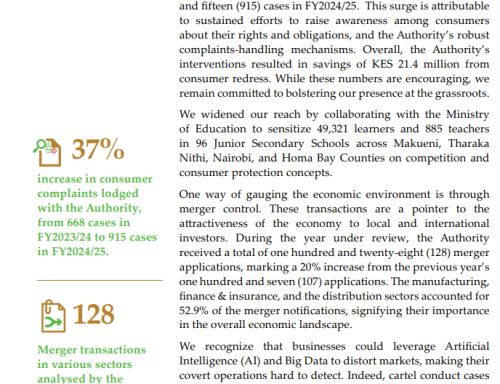
By Kenneth Mwenda, July 21, 2026The Competition Authority of Kenya (CAK) handled a record 915 consumer complaints in the financial year ending June 30, 2025, marking a 37 per cent increase from 668 cases recorded the previous year as more Kenyans sought redress over unfair business practices.
The figures, contained in the Authority’s FY2024/25 Annual Report and Financial Statements, show growing public awareness of consumer rights and increased confidence in the regulator’s complaints-handling system.
Director-General David K. Kemei said the rise reflected both greater public awareness and stronger enforcement by the Authority.
“We have noted a 37 per cent increase in consumer complaints lodged with the Authority, increasing from six hundred and sixty-eight (668) cases in FY2023/24 to nine hundred and fifteen (915) cases in FY2024/25. This surge is attributable to sustained efforts to raise awareness among consumers about their rights and obligations, and the Authority’s robust complaints-handling mechanisms,” the report read in part.
The complaints resulted in direct benefits for consumers. According to the report, the Authority secured Ksh21.4 million through refunds, repairs and product replacements after resolving disputes involving businesses in different sectors.
The report comes at a time when the regulator has stepped up scrutiny of retailers, manufacturers and service providers accused of misleading consumers. Recent investigations have focused on supermarkets over shelf prices that differ from checkout prices, misleading discounts and product labelling.
CAK says protecting consumers remains one of its key enforcement priorities alongside tackling anti-competitive practices and abuse of buyer power.
Board Chair Shaka Kariuki said the Authority achieved significant results during the reporting period despite a challenging global economic environment.
“The report highlights the Authority’s efforts to promote market competition and enhance consumer welfare, and also presents our financial performance.”
He noted that Kenya’s economy grew by 4.7 per cent in 2024, driven by agriculture, manufacturing, financial services, real estate and transport, creating an environment that attracted more investment and merger activity.
The Authority also completed the final phase of its Third Strategic Plan, achieving 93 per cent of its targets, up from 90 per cent in the previous planning cycle.
Beyond handling complaints, the regulator imposed Ksh1.44 billion in penalties against companies in the steel, retail and financial sectors for anti-competitive conduct.
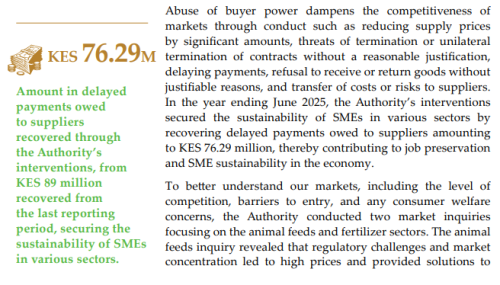
Its interventions also generated more than Ksh900 million in consumer savings in the paints and cement industries while recovering Ksh76.29 million owed to small and medium-sized enterprises by powerful buyers.
CAK expands consumer protection
The report further shows that merger activity remained strong. CAK reviewed 128 merger applications during the year, a 20 per cent increase from 107 the previous year. The Authority says the approved transactions unlocked investments worth more than Ksh25 billion, creating jobs and increasing consumer choice.
To strengthen consumer protection, CAK expanded its public awareness programmes. Working with the Ministry of Education, it reached 49,321 learners and 885 teachers in 96 junior secondary schools across Nairobi, Homa Bay, Makueni and Tharaka Nithi counties.
The regulator also acknowledged emerging challenges in the digital economy.
Kemei said businesses increasingly use Artificial Intelligence and Big Data, making anti-competitive conduct such as cartels harder to detect.
To respond, the Authority established a forensic laboratory to improve evidence collection and investigation of complex competition cases.
The report also highlights studies carried out in the animal feeds, fertiliser and internet service sectors, as well as an evaluation of competition in Kenya’s supermarket industry. CAK says the findings will guide future enforcement and policy reforms aimed at improving market competition and consumer welfare.
Looking ahead, Kemei said the Authority plans to intensify investigations into price fixing, abuse of dominance and other anti-competitive practices while expanding consumer protection efforts across the country.
“By the end of the planning period, we intend to increase our consumer-related cases by 120%, comprising cases submitted by Kenyans as well as investigations initiated on our own volition.”
The report comes months after President William Ruto appointed former Meru Governor Kiraitu Murungi as the Competition Authority of Kenya (CAK) board chairperson for a three-year term. Murungi is expected to provide strategic oversight as the regulator strengthens enforcement against anti-competitive practices and expands consumer protection efforts.