Challenges rural real estate investors contend with
By Cynthia Atuo, July 24, 2025Popular media and local culture have further fuelled this perception, painting real estate investors as affluent individuals living in leafy suburbs and cruising in top-of-the-range vehicles.
This has led to a widespread belief that the sector offers passive income with minimal effort—especially through rental earnings that seem consistent and guaranteed.
This portrayal has contributed to the widespread belief that real estate provides a steady, passive income stream through rent, making it appear as a low-effort, high-reward investment.
Unsurprisingly, this perception has captured the interest of younger generations, many of whom are now eager to enter the sector, drawn by its apparent promise of stability and returns.
While the potential for profit is certainly real, the journey is far from effortless. Real estate investment—particularly in rural areas—comes with its own set of challenges that are often overlooked.
From infrastructure limitations to fluctuating demand and regulatory hurdles, investors must navigate a range of complexities to succeed in this evolving market.
At the heart of Kapenguria town in West Pokot County lies the ‘Kapenguria Krall,’ one of the top four tallest commercial buildings in the rural region.
From outside, the building looks captivating, its curtain wall design borrowed from Singapore literally reflecting a lot of businesses going around in the area.
The blue colour blends well with the skies, and you can notice from far away as you enter the town: a sight for sore eyes after a long journey of just staring at the vast lands of maize that lead to the town.
It’s definitely the kind of building that will make you think, “He must be raking in a lot of money.’’
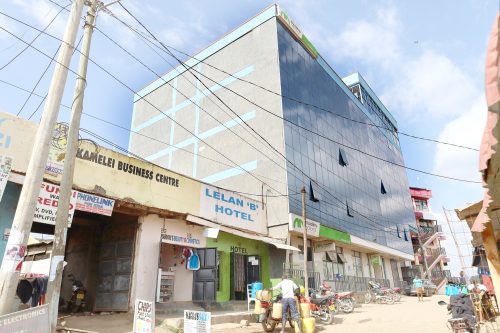
Onyango, a retired teacher, explains that while the commercial building looks serene and is mostly associated with affluence, the business comes with many challenges, some mostly tied to the rural setup.
“Initially, I wanted to put up a chain of shops, but one of my friends, who is an engineer, advised me to build a rental building, which could match my status as a teacher. I settled for a commercial building and started the actual building in 2024,’’ he says.
Despite the building being in its last stages of completion and already housing major corporate clients like the Kenya Revenue Authority and Kenya Power branches in Kapenguria, it only has a 40 per cent occupancy rate and has not proved profitable for the investor.
Onyango observes that the building, which was built from multiple SACCO loans, has yet to make him any profits and hopes that by the time it is complete, it will have attracted more complete clients.
“I will not say it has been profitable. The occupancy rate is still low, and the loan borrowed to finance the construction, and especially towards finishing the projects, has to be serviced. Additionally, I have to pay a 30 per cent tax, which is mandatory, and so we realised that it is a tough job,” he says.
According to the investor, the low occupancy rate is mainly attributed to a low demand for office space in the area, which has long been characterised as an unruly region of cattle rustling.
“You would expect big insurance companies and even hospitals to come and check numbers here, especially due to the high population and diverse business activities. But, many people still have that fear of coming to this area,’’ notes Onyango.
Additionally, he observes that the lack of marketing and advertising for the county has dwindled businesses for real estate investors in the area and is calling for more positive exposure as opposed to the negatives.
In Kisumu County, another realtor who doubles up as a contractor also faces a different set of challenges in the sector.
Philip Otieno owns two rental residential apartments in Migosi and Kaloleni (still incomplete) areas in Kisumu County.
And despite the high demand for residential apartments, especially from young people and young families, which has made his venture profitable, he notes that labour, especially during construction, is very expensive.
“Labour is always available, but it is only available if you have money. It is very expensive because you have to pay them on a daily basis. Currently, skilled labourers and technicians in construction earn approximately Ksh1,200 per day, while the unskilled workers get Ksh500,” he says, adding that the price can fluctuate depending on the nature of the job for the day.
He notes that on days when he does not have money to pay the labourers, he is always forced to pause the construction until further notice.
In addition, he emphasises that getting approvals as a contractor can also be a big challenge.
Regular inspections from county officers are also a pain in the neck, as it comes with its own extra challenges and expenses.
“The county officers usually make a lot of visits, and they are always unwilling to produce their records. So nowadays I refuse to let in any officer who comes in for inspection and doesn’t have their own record,” he says, adding that he must also verify county officer documents to avoid being swindled.
Otieno further notes that he has had to restructure his building, which was once a commercial building, into a residential one because during the COVID-19 pandemic, he barely had clients and was running at a loss.
“The building in Migosi was initially a commercial building, but I had to partition it into small residential spaces. During the Covid-19 period, I was making no money and had to re-strategise,” he notes.
Elsewhere in Meru County, Mkonge Mwiria, who has built rentals at Igoji in Nkubu area, says the biggest challenge he faces is when tenants move without paying rent due.
“Because of the economic pressure, some of those who have rented will keep giving excuses to why they will not pay and eventually run away. Sometimes you are forced to do things that you are not supposed to do like chasing them away or locking them out, which is really against my principles, but because it is business, you have to,” he says.
Another challenge he faces as a realtor is poor drainage, which is worse in Nkubu. Due to this, he is always forced to exhaust every three weeks, and it becomes very expensive.
More notably, since his rentals are near Mount Kenya University with most of his tenants comprising students, Mwiria notes that when the university closes, the market usually goes down.