Advertisement
Central Bank seeks public input on expanding quality financial service
Thursday 25th September, 2025 10:47 AM|

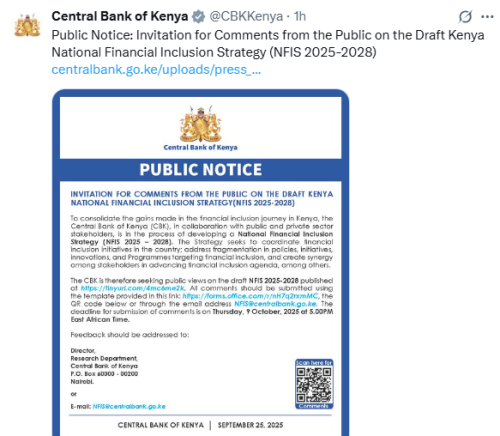
The Central Bank of Kenya (CBK) has called on Kenyans to share their views on the Draft National Financial Inclusion Strategy (NFIS) for 2025 to 2028.
According to the notice, on Thursday, September 25, 2025, the strategy aims to guide the next phase of Kenya’s journey in expanding access to quality financial services for all.
“To consolidate the gains made in the financial inclusion journey in Kenya, the Central Bank of Kenya (CBK), in collaboration with public and private sector stakeholders, is in the process of developing a National Financial Inclusion Strategy (NFIS 2025 – 2028),” the notice reads.
“The Strategy seeks to coordinate financial inclusion initiatives in the country; address fragmentation in policies, initiatives, innovations, and Programmes targeting financial inclusion; and create synergy among stakeholders in advancing financial inclusion agenda, among others.”
You Might Also Like



The draft, developed with the support of both public and private sector stakeholders, builds on the progress already made in bringing more people into the financial system. According to CBK, the plan will help coordinate initiatives, reduce duplication, and create stronger partnerships across government, industry, and civil society.
Kenya has made significant strides in financial inclusion. As of 2024, 84.8 per cent of adults had access to formal financial services, compared to less than 30 per cent two decades ago. However, CBK notes a worrying trend: financial health, which measures how well people manage their money and withstand shocks, has fallen sharply from 39.6 per cent in 2016 to just 18.3 per cent in 2024. This shows that having a bank or mobile money account does not always translate to financial stability.
Six pillars driving inclusion
The new strategy addresses this gap by focusing on six key pillars. First, it seeks to deepen access by expanding digital and physical infrastructure, with a focus on rural areas, young people, and displaced communities. Second, it will enhance usage and quality by making financial products more affordable and relevant, while supporting innovations such as open finance and faster payment systems.
Third, the plan proposes stronger consumer protection and financial literacy measures. It highlights the need for a clear market conduct framework, tougher action against predatory lending, and a national drive to improve financial skills. Fourth, the strategy places emphasis on green finance. It encourages investments that support climate goals, such as green bonds, and plans to operationalise the Kenya Green Finance Taxonomy.
The fifth pillar targets agriculture, especially smallholder farmers who form the backbone of rural livelihoods. Tailored products like crop insurance and value chain financing are part of the proposals. Finally, the sixth pillar aims to make finance more inclusive for vulnerable groups such as women, youth, persons with disabilities, and small businesses. It also introduces a “WE Finance Code” to promote women’s financial empowerment.

Strong oversight and monitoring
To oversee the plan, CBK proposes a strong governance structure. A National Financial Inclusion Council, co-chaired by the Treasury Cabinet Secretary and the CBK Governor, will provide high-level guidance. Technical committees and thematic working groups will drive implementation, while a dedicated NFIS Secretariat at CBK will manage day-to-day coordination.
Monitoring progress will be a central part of the strategy. Data from surveys such as FinAccess will be used to track indicators, with the ultimate goal of improving the Multidimensional Financial Health Index.
CBK has published the draft strategy on its website and invited comments from the public. Feedback can be submitted online through a template, by email, or via a QR code provided in the notice. The deadline for submissions is Thursday, October 9, 2025, at 5.00 pm East African Time.
Author
Kenneth Mwenda
Kenneth Mwenda is a business, sports, and politics digital writer with over seven years of experience in journalism, covering breaking news, feature stories, and in-depth analysis across a range of beats.
For inquiries, he can be reached at [email protected]
View all posts by Kenneth MwendaLatest News








Advertisement
More on Business