CBK: NSE indices rise despite lower trading volumes
By Faith Lagat, March 21, 2026The Nairobi Securities Exchange (NSE) indices edged higher during the week ending March 18, 2026, reflecting cautious optimism among investors despite significantly reduced trading activity.
According to the Central Bank of Kenya’s Weekly Bulletin released on March 19, 2026, the Nairobi All-Share Index (NASI) rose by 0.11%, closing at 211.29.
The NSE 25 share index posted a stronger gain of 1.19%, while the NSE 20 index advanced by 0.50%. Market capitalisation also inched up by 0.12% to approximately Ksh 3,503.94 billion.
This upward movement occurred amid a sharp decline in liquidity. Total shares traded declined by 60.45%, and equity turnover fell by 63.25%to 81.33 million shares and Ksh 2,448.04 million, respectively.
The number of equity deals also fell by 23.83%, signalling lower investor participation, which analysts attribute to end-of-week positioning, anticipation of upcoming economic data, or a cautious approach amid global uncertainties.
“At the Nairobi Securities Exchange, the NASI, NSE 25, and NSE 20 share price indices increased by 0.11 percent, 1.19 percent, and 0.50 percent, respectively, during the week ending March 18, 2026. Market capitalisation increased by 0.12 percent, while total shares traded and equity turnover decreased by 60.45 percent and 63.25 percent, respectively.”
Global trends influence domestic market
Several factors contributed to the subdued trading environment. Globally, market uncertainty persisted as major central banks maintained steady interest rates. The U.S. Federal Reserve and Bank of Canada held rates amid ongoing inflation concerns.
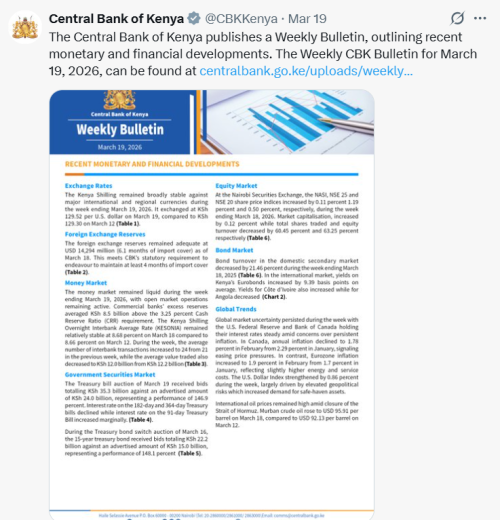
While Canada’s annual inflation eased to 1.78% in February from 2.29% in January, Eurozone inflation rose slightly to 1.9% from 1.7%, driven by higher energy and service costs. Geopolitical risks increased demand for safe-haven assets, strengthening the U.S. Dollar Index by 0.86%. International oil prices remained elevated due to the closure of the Strait of Hormuz, with Murban crude climbing to Ksh 12,380 per barrel on March 18 from USD 92.13 on March 12.
Bond market activity
In the domestic bond market, secondary-market turnover declined by 21.46%. Kenya’s Eurobond yields rose by an average of 9.39 basis points, with the 10-year (2028) yield increasing to around 6.69%. Yields for Côte d’Ivoire also rose, while Angola’s declined.
The Kenyan shilling remained relatively stable against major currencies during the week of March 13-19, averaging 129.44 against the USD.
CBK foreign exchange reserves stood at USD 14,294 million as of March 18, providing about 6.1 months of import cover. Interbank rates (KESONIA) hovered steadily around 8.68%, while Treasury bill and bond auctions showed mixed demand, with average interest rates on longer-tenor papers trending slightly lower in some cases.
Overall, the week’s performance highlights resilience in equity valuations despite thin liquidity, with investors maintaining selective positions amid ongoing global and domestic developments.