CBK confirms international oil prices increase ahead of EPRA fuel review
By Faith Lagat, April 10, 2026Oil prices remain elevated ahead of the Energy and Petroleum Regulatory Authority (EPRA) monthly fuel price review, as geopolitical tensions in the Middle East continue to influence global crude markets.
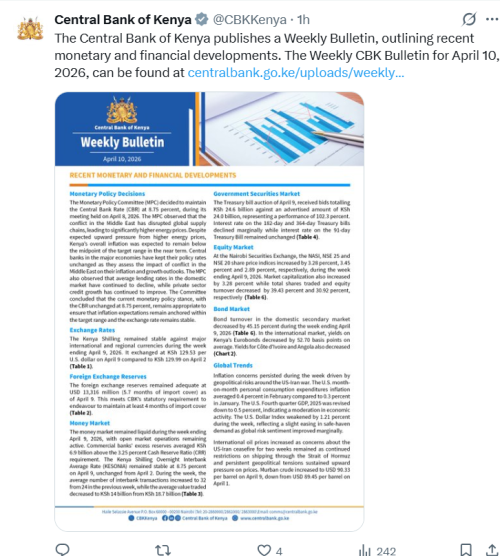
According to the Central Bank of Kenya (CBK) Weekly Bulletin released on April 10, 2026, international oil prices increased during the week, driven by concerns over a fragile US–Iran ceasefire.
Restrictions on shipping through the Strait of Hormuz and ongoing security risks sustained upward pressure on prices.
Murban crude, a key benchmark for Kenya’s oil imports, rose to about Ksh11,730 per barrel on April 9 from about Ksh11,616 per barrel on April 1, based on an average exchange rate of Ksh129.86 to the US dollar.
“International oil prices increased as concerns about the US-Iran ceasefire for two weeks remained as continued restrictions on shipping through the Strait of Hormuz and persistent geopolitical tensions sustained upward pressure on prices. Murban crude increased to USD 90.33 per barrel on April 9, down from USD 89.45 per barrel on April 1,” CBK reported.
Global oil movement and supply risks
The CBK report shows that global crude markets recorded gains during the review period, with geopolitical developments in the Middle East shaping price movements.
The weakening of the US–Iran ceasefire and continued disruptions in maritime routes through the Strait of Hormuz contributed to tighter supply expectations. These conditions supported upward movement in crude benchmarks, including Murban oil.
The price level near Ksh11,730 per barrel places additional focus on Kenya’s upcoming EPRA fuel price review, typically announced around the 14th of each month. Kenya continues to rely on imported refined petroleum products, making domestic fuel costs highly sensitive to global price changes.
In the previous March–April 2026 EPRA cycle, pump prices in Nairobi remained unchanged at Ksh178.28 for super petrol, Ksh166.54 for diesel, and Ksh152.78 for kerosene, reflecting earlier cargo pricing before recent global price increases.
Ahead of April 14, 2026, the Competition Authority of Kenya (CAK) has issued a stern warning to Oil Marketing Companies (OMCs) following reports of fuel hoarding and unconscionable conduct amid concerns over nationwide fuel availability.
The authority noted that the intervention follows growing public discourse and government indications that certain OMCs may be deliberately withholding the supply of essential products, including petrol, diesel, kerosene, and Jet A-1, in anticipation of price increases.
Exchange rate performance and financial indicators
The Kenyan shilling traded at an average of Ksh129.86 against the US dollar during the week ending April 9, closing at Ksh129.53 on April 9. Foreign exchange reserves stood at approximately Ksh1.73 trillion (equivalent to USD 13,316 million), providing 5.7 months of import cover.