Advertisement
Political parties urged to include Animal Welfare in their manifestos
Tuesday 08th February, 2022 12:14 AM|
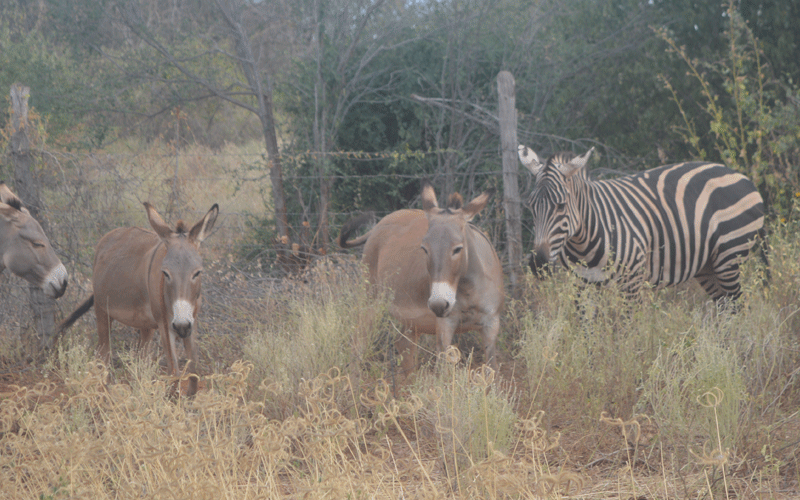
Animal welfare is still a key challenge in Kenya, just like any other developing economies.
Most of the times, this issue is never a top priority for any government hence the maltreatment of animals in Kenya.
But as the country draws near to a General Elections in August. Animal activist are watching closely to politicians who eyeing the presidency seat.
The question that all Kenyans should ask all politicians is “What plan do you have on the welfare for our animals?”
According to the Kenya-Economic-Report-2020, crop and livestock Sectors have significant potential to contribute to inclusive growth because it is the main economic activity for most households living in the rural areas. For this to be achieved, enhanced use of all factors of production (land, labour and capital) are required in addition to an enabling policy environment. As of 2016, agriculture contributed about 33-36% of GDP, forms 65 per cent of Kenya’s total exports and provides 18 per cent of formal employment. This should be supported by complementary investments to support provision of extension services, provision of market infrastructure and use of information and communication technology.
Animals such as donkeys and oxen are critical support assets in small scale agriculture as they carry out land preparation, harvest and post-harvest operations most importantly for transport.
Currently, there are approximately 1.1 million donkeys down from 1.8 million donkeys in 2009. This is according to Kenya National Bureau of Statistics data.
Dr Raphael Kinoti, Regional Director Brooke East Africa say this sharp decline can be linked to “Export slaughter of donkeys between 2017 and 2020 to supply donkey hide in Chinese markets for making ‘Ejiao’, a gelatine used in traditional medicine of the country.”
Policy actors should take note of the threat to indigenous livestock such as the donkey.
“The donkey works the most in farms, urban areas, households as well as in the driest parts of Kenya. However, communities still lack knowledge on their welfare with many still holding many negative beliefs on the animal.” Kinoti explains.
He adds “The donkey is yet to be fully integrated in the planning on livestock buy the government of Kenya. It is still referred to as an “emerging livestock” hence very little is done in terms of resource allocation in the development of this livestock species.
Stakeholders and animal welfare promoters now want political parties to state their plan for animal welfare before going out to seek votes from voters who have suffered for lack of it in previous regimes.
“Every political party needs to input animal welfare in their manifesto as a recognition that millions of communities in Kenya depend on this resource. Kenya cannot make to the next level of development without proper integration of animal welfare in the mainline development. “Kinoti says.
He adds “These manifestos should focus on the entire livestock sector and carry with them some political goodwill. We urge political formations to establish a animal welfare developed clause that will propel placement of welfare standards in the country as opposed suggesting policy recommendations.”
Experts argue that capacity building of communities for care and development of livestock including the provision of drugs and treatment services, provision of animal health personnel and integration of programmes are key in the promotion of animal welfare.
Martin Ndungu a small scale dairy farmer in Ol Kalou town, Nyandarua County, recounts the years when the agricultural sector made most families millionaires because of the support from the government.
“The jobs we are talking about can be achieved if we support the agricultural value chain whereby the small-scale farmers can have access to market. recommends Ndungu.
“Politicians should present a clear roadmap on their intention to revamp agricultural sector. He adds.
His sentiments are shared with Margaret Mumbua a donkey owner in Yatta, Machakos County.
“A donkey is my only source of income. I had four of them before I lost them to theft.”
Author
Steve Umidha
View all posts by Steve UmidhaLatest News

Advertisement