World Met warns of possible El Niño return between May–July 2026
By Faith Lagat, April 24, 2026The World Meteorological Organization (WMO) has issued a high-confidence alert that an El Niño event is likely to emerge between May and July 2026, with models suggesting it could develop into a strong episode lasting nine to twelve months.
The latest Global Seasonal Climate Update, dated Friday, April 24, 2026, indicates a rapid rise in equatorial Pacific sea-surface temperatures following a period of neutral ENSO conditions after the 2025–26 La Niña.
“Climate models are now strongly aligned, and there is high confidence in the onset of El Niño, followed by further intensification,” Wilfran Moufouma Okia, Chief of Climate Prediction at WMO, said.
He noted that while the spring predictability barrier poses some uncertainty, forecast confidence typically improves after April 2026.
How El Niño occurs
El Niño, the warm phase of the El Niño–Southern Oscillation (ENSO), is characterised by warming of ocean surface temperatures in the central and eastern equatorial Pacific.
It typically occurs every two to seven years and lasts about nine to twelve months. The WMO notes that each event differs in evolution and impact, influencing rainfall, temperature, and extreme weather patterns across multiple regions.
“El Niño is characterised by a warming of ocean surface temperatures in the central and eastern Equatorial Pacific. It typically occurs every two to seven years and lasts around nine to twelve months,” read part of the WMO statement.
Climate outlook and regional impacts
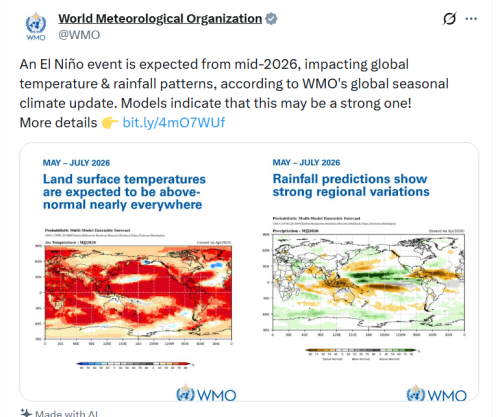
The WMO projects near-global dominance of above-normal land surface temperatures for the May–July 2026 season.
Strong signals are expected over southern North America, Central America, the Caribbean, Europe, and Northern Africa. Rainfall forecasts indicate strong regional contrasts, with wetter-than-normal conditions projected in the Horn of Africa, southern South America, southern United States, and parts of central Asia, while drier conditions are expected in Australia, Indonesia, and sections of southern Asia.
During the boreal summer, El Niño conditions can influence tropical storm activity, typically increasing hurricane formation in the central and eastern Pacific while suppressing activity in the Atlantic basin.
The WMO states that while there is no evidence that climate change increases the frequency or intensity of El Niño events, a warmer global background can amplify associated impacts such as heatwaves, heavy rainfall, and drought.
Kenya experience and preparedness
Kenya experienced severe impacts during the 2023–2024 El Niño event, including widespread flooding that affected multiple counties. Government records show at least 174 fatalities, displacement of over 109,000 households at peak, and significant infrastructure damage.
Agriculture losses were estimated at Ksh16.26 billion, including crop destruction and livestock deaths in counties such as Garissa, Wajir, Lamu, Tana River, and Kitui.
The 1997–98 El Niño also caused major flooding across the region, disrupting transport and isolating communities for extended periods. With forecasts indicating increased rainfall potential in parts of the Horn of Africa, preparedness measures are being emphasized across government agencies and humanitarian partners.
The WMO is expected to release its next El Niño/La Niña Update in late May 2026, providing further guidance for national and regional planning. National Meteorological and Hydrological Services continue to issue localised forecasts to support early warning and preparedness efforts.