Willis Otieno: Parliament has no role in MoUs signed by Kenya
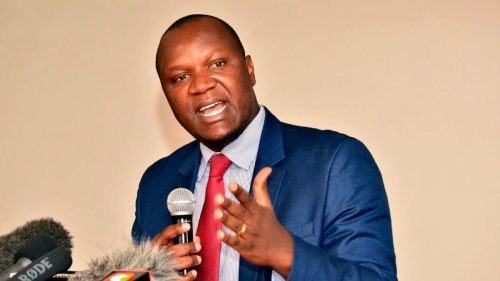
By Kiprono Keileb, December 9, 2025Lawyer and political commentator Willis Otieno has weighed in on the ongoing public debate over the legality and oversight of agreements recently signed by the Ministry of Health.
He has insisted that Parliament has no lawful mandate to approve Memoranda of Understanding (MoUs) or Health Financing Agreements.
In his statement posted on X on Tuesday, December 9, 2025, Otieno argued that concerns being raised about the agreements stem from a misunderstanding of what MoUs legally represent and how they have historically been handled within government.
He stated that Kenya’s laws do not require such agreements to be tabled before Parliament or vetted by the Attorney-General.
“Kenya has no statutory requirement compelling MoUs or Health Financing Agreements to be submitted to the Attorney-General or Parliament after they are signed,” he said.
Otieno added that the Ministry of Health has signed similar agreements with global partners for years without ever involving Parliament or triggering public participation processes.
“As things stand, the Executive, particularly through the Ministry of Health, has already signed dozens of similar agreements with international actors: the Global Fund, the Embassy of the Netherlands, the Norwegian government, and various global health corporations,” he noted.
He pointed out that none of those previous MoUs were subjected to legislative scrutiny.
“None of those MoUs ever went through Parliament. None were tabled for legislative scrutiny. None triggered public participation,” he stated.
Otieno said the reason is simple: MoUs do not fall into the category of formal treaties or binding legal commitments that require parliamentary oversight.
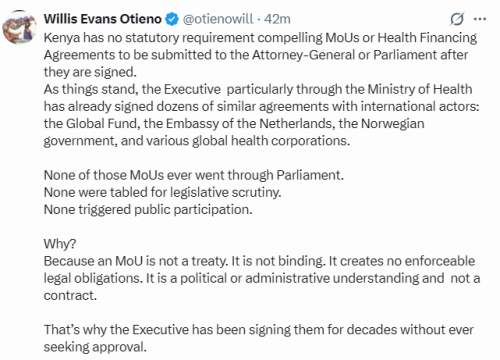
“Why? Because an MoU is not a treaty. It is not binding. It creates no enforceable legal obligations. It is a political or administrative understanding and not a contract,” he explained.
He argued that this longstanding practice shows the Executive has always exercised the authority to sign such agreements without seeking approval.
“That’s why the Executive has been signing them for decades without ever seeking approval,” he added.
Otieno’s remarks come at a time when questions around transparency, accountability, and the scope of executive power have stirred intense public debate after the recent agreement signed between Kenya and the United States. Otieno clarifies where the law places MoUs in Kenya’s governance framework.