Advertisement
Willis Otieno: Kenyans should not pay for corruption dressed up as loans
Saturday 20th September, 2025 02:41 PM|

Lawyer Willis Otieno has questioned the essence of Kenyan taxpayers being subjected to paying off expensive loans taken by the state when there is little to show for it.
Taking to his account on Saturday, September 20, 2025, Otieno reacted to a statement by business mogul and politician Jimi Wanjigi over the details of the 2014 Eurobond, whose purpose was not achieved.
“In 2014, Kenya took a $2 billion (Ksh258.3 billion) Eurobond. We have investigated that bond extensively, and the revelations will be mind-boggling. That money is anchored nowhere in any development project, and $1 billion (Ksh129.1 billion) never even came to Kenya, yet this year we are supposed to pay back that money,” Wanjigi said, according to the statement dated July 12, 2023.
On his part, Willis Otieno argued that it is high time Kenyans refused servicing debts that have no significance to the common citizen.
You Might Also Like



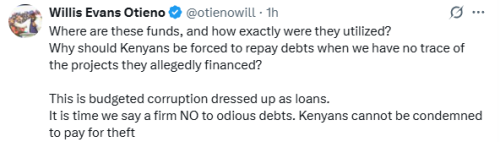
”Where are these funds, and how exactly were they utilised? Why should Kenyans be forced to repay debts when we have no trace of the projects they allegedly financed? This is budgeted corruption dressed up as loans. It is time we say a firm NO to odious debts. Kenyans cannot be condemned to pay for theft,” Otieno said.
Otieno faults Parliament
Recently, Otieno took a hardline stance against Parliament, accusing it of betraying the Kenyan people by turning a blind eye to what he described as a massive heist of public funds through the eCitizen platform.
In a statement posted on his official X account on Tuesday, August 6, 2025, Otieno raised alarm over irregular payments made through the eCitizen system, painting a grim picture of state-sanctioned financial misconduct and institutional failure.
“By June 2024, the Kenyan government had already paid Ksh492 million and 414,000 USD for eCitizen platform services, but here’s the bombshell: the money did not go to the contracted service provider. Instead, it was funnelled to a shadowy entity called Electronic Citizen Solutions, a company with no legal contract with the government,” he stated.
“No legal policy framework was ever established. No public oversight mechanisms were put in place,” Otieno said, warning that the scale and audacity of the alleged fraud reflect deeper institutional rot.
Author
Latest News








Advertisement
More on News