Willis Otieno faults Mbadi over proposed mitumba tax model
By Emmanuel Rono, May 17, 2026Lawyer Willis Otieno has criticised Treasury Cabinet Secretary John Mbadi over the proposed taxation model targeting the mitumba sector, warning that it could cripple small traders and increase the cost of basic clothing for millions of Kenyans.
In a statement on Sunday, May 17, 2026, Otieno accused Mbadi of introducing what he referred to as a “deeply flawed” taxation system that would force mitumba traders to pay income tax based on assumed profits before selling their goods.
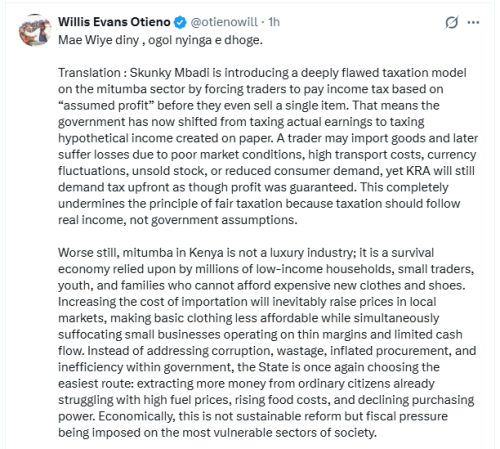
According to Otieno, the proposed system shifts taxation from actual earnings to hypothetical income, arguing that traders could still be taxed even when they make losses due to poor market conditions, high transport costs, currency fluctuations, unsold stock, and weak consumer demand.
“A trader may import goods and later suffer losses due to poor market conditions, high transport costs, currency fluctuations, unsold stock, or reduced consumer demand, yet KRA will still demand tax upfront as though profit was guaranteed,” Otieno stated.
“This completely undermines the principle of fair taxation because taxation should follow real income, not government assumptions.”
Inside 5% mitumba tax scrap
The Kenyan Finance Bill, 2026, resulted in a change to the taxation of Mitumba, which were previously proposed to be taxed at a 5 per cent import duty and have now been replaced by a simplified, one-off import duty system. The move is part of broader reforms to customs charges, which aim to simplify them and limit them to a single border tax.
The removal of the 5 per cent tax is one of the most significant changes to the initial proposal by the Treasury to impose the tax to help streamline the collection of revenues from imported second-hand clothes.

“They expressed frustrations… They asked for a simplified tax system where they pay at the point of entry and no one comes again to demand for any taxes,” Mbadi said.
Under the proposed system, traders would pay a presumptive tax based on 5 per cent of the customs value of imported goods, with a 30 per cent tax applied to that value, resulting in an effective 1.5 per cent final tax.
Mitumba is not a luxury
Otieno has further argued that the mitumba business is not a luxury trade but a survival economy supporting millions of low-income households, youth, and small-scale entrepreneurs who rely on affordable second-hand clothes and shoes.
He warned that increasing importation costs would likely push up prices in local markets, making clothing less affordable for ordinary Kenyans while squeezing traders already operating on limited cash flow and thin profit margins.

“Worse still, mitumba in Kenya is not a luxury industry; it is a survival economy relied upon by millions of low-income households, small traders, youth, and families who cannot afford expensive new clothes and shoes,” Otieno stated.
He added that increasing the cost of importation will inevitably raise prices in local markets, making basic clothing less affordable while simultaneously suffocating small businesses operating on thin margins and limited cash flow.