Willis Otieno: 2026/27 budget does not reflect a people-first philosophy
By Mustafa Juma, June 16, 2026Constitutional lawyer and governance analyst Willis Otieno has sharply criticised Kenya’s 2026/27 national budget, arguing that it fails to place ordinary citizens at the centre of government policy and instead places additional pressure on households already struggling with the high cost of living.
In a statement issued via his official X account on Tuesday, June 16, 2026, following the presentation and approval of the 2026/27 budget, Otieno said the spending plan reflects a fiscal framework that prioritises expenditure commitments over the welfare of citizens.
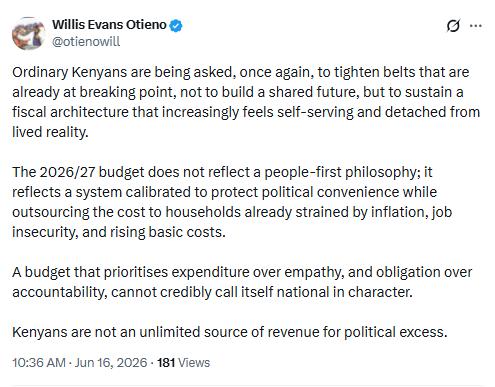
“Ordinary Kenyans are being asked, once again, to tighten belts that are already at breaking point, not to build a shared future, but to sustain a fiscal architecture that increasingly feels self-serving and detached from lived reality,” Otieno stated.
2026/27 budget
His remarks add to the growing public debate over the government’s spending priorities, taxation policies, and borrowing plans following the unveiling of the Ksh4.82 trillion budget for the 2026/27 financial year.
According to Treasury Cabinet Secretary John Mbadi, the budget is intended to accelerate economic growth, strengthen social protection, and support key sectors of the economy.
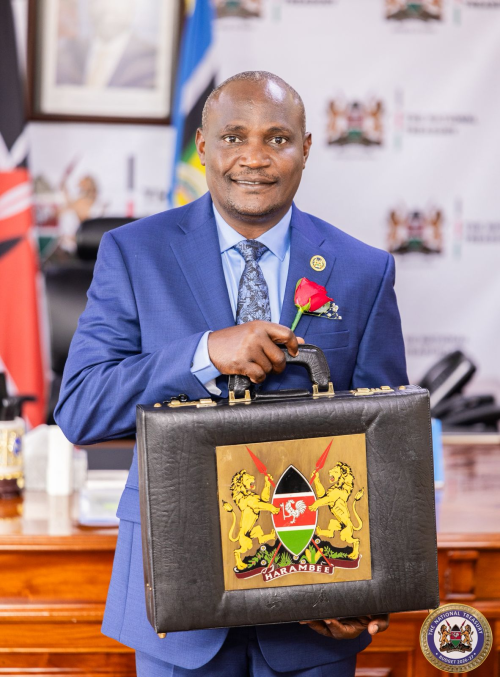
The budget allocates Ksh781.4 billion to education, making it the largest beneficiary of government spending. The health sector received Ksh175.5 billion, including allocations aimed at strengthening Universal Health Coverage, primary healthcare services, and treatment for chronic and critical illnesses.
County governments are set to receive Ksh428 billion as their equitable share of revenue following a prolonged standoff between the National Assembly and the Senate, while the Equalisation Fund received Ksh10.25 billion to support development in marginalised regions.
Economic realities facing Kenyans
Despite the significant allocations, Otieno argues that the budget fails to adequately address the economic realities facing many Kenyans.
“The 2026/27 budget does not reflect a people-first philosophy; it reflects a system calibrated to protect political convenience while outsourcing the cost to households already strained by inflation, job insecurity, and rising basic costs,” he said.
The lawyer further questioned whether government spending priorities are aligned with the challenges facing ordinary citizens, particularly as households continue to grapple with elevated food prices, unemployment, and increasing costs of essential services.
“A budget that prioritises expenditure over empathy, and obligation over accountability, cannot credibly call itself national in character,” he added.
The government has defended the budget as a balanced framework designed to promote growth while maintaining fiscal discipline. Treasury projections indicate total revenue collections of approximately Ksh3.6 trillion against planned expenditure of Ksh4.82 trillion, leaving a fiscal deficit that will be financed through a combination of domestic and external borrowing.
Officials maintain that investments in education, healthcare, infrastructure, housing, agriculture, and social protection programmes are necessary to drive economic expansion and improve service delivery across the country.
However, critics such as Otieno contend that the conversation should not focus solely on expenditure figures but also on how government resources are utilised and whether citizens are receiving value for the taxes they pay.
“Kenyans are not an unlimited source of revenue for political excess,” he stated.
His comments are likely to resonate with sections of the public still recovering from economic shocks and ongoing debates surrounding taxation and public spending.
As implementation of the 2026/27 budget begins, scrutiny is expected to intensify over how government agencies utilise allocated funds and whether the promised investments translate into tangible improvements in the lives of ordinary Kenyans.