Why refugee girls are losing education race despite free schooling
By Aloys Michael, May 16, 2026Kenya’s promise of free basic education is failing one of the country’s most vulnerable groups, refugee girls.
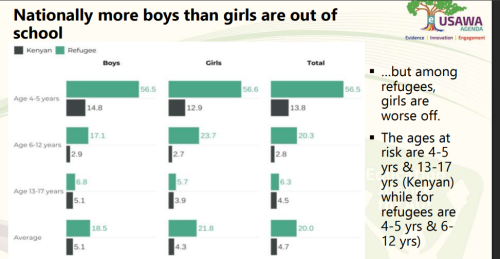
A new national gender report on education has revealed a troubling reality inside refugee communities: while boys are generally more likely to be out of school across Kenya, the trend reverses sharply in refugee settings, where girls are falling behind at alarming rates.
The report warns that refugee girls are becoming invisible victims of poverty, poor infrastructure, weak bursary support and gender-based exclusion.
The findings are contained in the 2026 Gender Equality in Basic Education Status Report by Usawa Agenda, which assessed more than 81,000 children and visited schools across all 47 counties.
“Nationally, more boys than girls are out of school except among the refugee communities,” the report states, adding a hidden education crisis affecting girls in camps and refugee settlements.
The study further found that refugee children are most vulnerable to dropping out between ages six and 12 years, considered critical for foundational learning.
The findings raise serious questions about whether Kenya’s education policies are reaching displaced learners despite constitutional guarantees on free and compulsory education.
According to the survey, the crisis begins with poverty and deepens through exclusion from bursary opportunities.
“across different bursary sources, more boys’ senior schools than girls’ and mixed schools have learners receiving bursary support,” the study notes, suggesting that vulnerable girls, especially those in refugee communities, may be missing out on financial aid needed to stay in school.
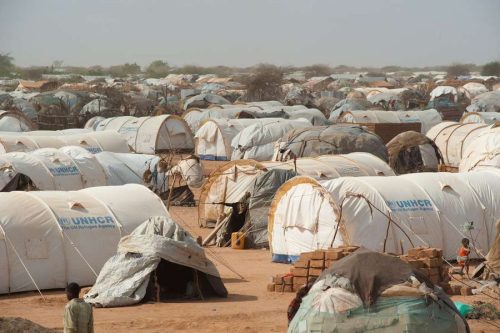
In camps such as Dadaab and Kakuma, many refugee families struggle to afford uniforms, sanitary products, transport and meals despite tuition being free. School heads interviewed during the study also pointed to overcrowding and inadequate facilities as barriers to girls’ education.
The sanitation situation is particularly dire.
Access to basic needs
The report found that refugee community schools have among the worst access to handwashing facilities, with hundreds of learners often sharing a single washing point. It also noted that many schools provide sanitary towels but lack safe changing rooms and menstrual hygiene facilities for girls.
“Limited access to basic hygiene facilities may compromise girls’ comfort, dignity, attendance and overall participation in learning,” the report warns.
For adolescent girls, the consequences can be devastating.
According to the study, an out-of-school girl is more than 12 times more likely to experience a teenage pregnancy compared to girls who remain in class. Researchers also found that stigma remains the biggest obstacle preventing teenage mothers from returning to school after childbirth.
In refugee settings where access to healthcare, counselling and family support is already fragile, activists fear many girls who drop out never return to education.
The report also revealed another troubling trend: boys outperform girls academically in refugee schools, reversing the national pattern where girls generally perform better in literacy and numeracy at lower levels.
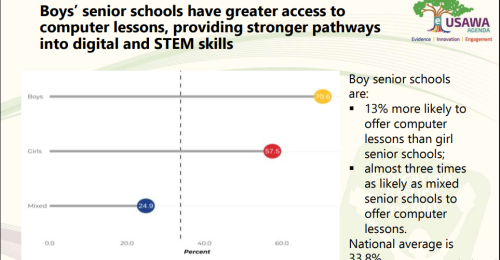
The study found that boys’ schools generally enjoy better facilities, stronger STEM support, more laboratories, better ICT resources and wider subject choices compared to girls’ schools.
“Boys enjoy comparatively stronger support in STEM pathways,” the report states.
For refugee girls already struggling with displacement and poverty, the inequalities become even harder to overcome.
Human rights groups are now calling for targeted bursary programmes for refugee girls, improved menstrual hygiene facilities in camp schools, and stronger reintegration support for girls who become pregnant while in school.