Why Kenya, Africa, faces a growing risk of missing the global AI boom
By Aloys Michael, May 8, 2026Kenya and other African economies risk being locked out of the global artificial intelligence boom as technological wealth and innovation become increasingly concentrated in advanced economies, a new World Economic Forum (WEF) report warns.
The report, Growth in the New Economy: Towards a Blueprint 2026, identifies information technology services as the world’s biggest growth sector by 2030, powered by rapid advances in artificial intelligence, frontier technologies and digital transformation.
Yet it cautions that countries unable to build strong technological and innovation capacity could fall even further behind in the emerging global economy.
For Kenya, often branded as Africa’s Silicon Savannah, the findings raise urgent questions about whether the country is building genuine AI competitiveness or merely becoming a consumer market for technologies developed in the United States, China and Europe.
“Technology and knowledge are increasingly central to value creation,” the WEF report states, warning that economies lacking the capacity to absorb, adapt and apply innovation may struggle to benefit from the next wave of economic growth.
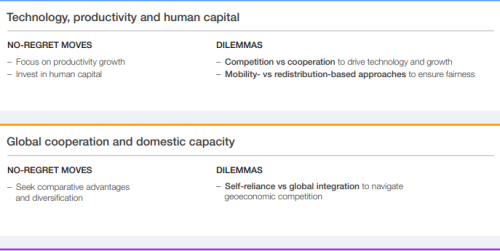
The report projects IT services to emerge as the dominant global growth industry between 2025 and 2030, outperforming sectors such as advanced manufacturing, healthcare and energy technology.
However, the same technologies creating trillion-dollar opportunities are also deepening fears of a new global AI divide, in which countries with weak digital infrastructure, low computing power and limited research investment risk permanent exclusion from the future economy.
“Technological disruption could concentrate gains among leading firms and regions, while widening capability gaps between countries, shaping frontier technologies and those dependent on adopting innovations developed elsewhere,” the report warns.
That warning carries particular weight for Sub-Saharan Africa, where governments are racing to digitise economies despite persistent barriers such as expensive electricity, inadequate infrastructure and skills shortages.
In Kenya, artificial intelligence adoption is growing rapidly across banking, agriculture, healthcare and education. Nairobi has attracted global technology firms and startups seeking to tap into East Africa’s young digital workforce.
Yet industry players say the country still lacks the large-scale computing infrastructure, semiconductor capacity and research funding needed to compete globally in AI development.
“Lack of skilled workforce, high costs of energy and commodities, and limited access to finance are among the key barriers slowing economic growth in many developing economies,” WEF observes.
Those challenges are increasingly significant as AI development becomes tied not only to software talent, but also to energy-intensive data centres, high-performance computing systems and advanced chip technologies dominated by a handful of global powers.
“Frontier technologies, from AI to advanced manufacturing and clean energy, are expanding the realm of economic possibility while reshaping production, security and value creation,” it notes.
Overdependence crisis?
But analysts warn Africa’s role in that transformation remains largely peripheral.
While Kenya has emerged as a continental leader in mobile money and fintech innovation, much of Africa’s digital economy still depends heavily on foreign-owned cloud infrastructure, imported hardware and externally developed AI systems.
That dependence has sparked growing concerns about digital sovereignty, with experts warning African countries could become consumers of AI products without controlling the underlying technology, data or profits.
The WEF report says competition over technology and innovation is now deeply intertwined with geopolitics, as countries invest aggressively in strategic industries and restrict access to critical technologies and materials.
This global technological race is increasingly reshaping investment flows, supply chains and economic influence.

“Traditional development pathways based on low-cost labour and export-oriented manufacturing are being disrupted by AI and robotics, threatening the model many African economies hoped would drive industrialisation,” the study cautions.
For Kenya and the wider African continent, the stakes are enormous.
With Sub-Saharan Africa projected to remain one of the world’s fastest-growing regions demographically, failure to secure a foothold in AI and frontier technologies could deepen unemployment, inequality and dependence on foreign technology platforms.
“The winners in the new economy will be those who understand competing threats and opportunities and build agile growth pathways,” the WEF report states.
For Africa, the challenge may now be whether it can move from being a market for artificial intelligence to becoming a creator of it.