WHO raises alarm over psychological impact of online violence
By Cynthia Lodite, February 7, 2026The World Health Organisation(WHO) has explained how online violence translates to mental scars as survivors are left to deal with the mental torture from such abuse.
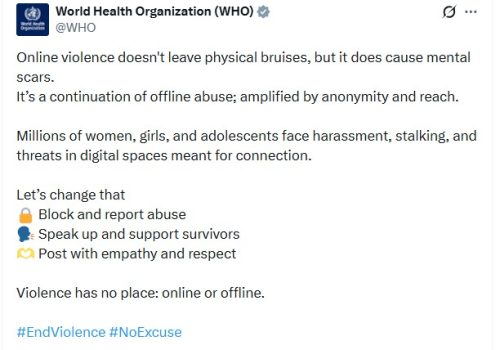
In a statement on the official WHO X account on Saturday, February 7, 2026, WHO noted that online abuse may not leave physical bruises, but instead cause mental scars which are amplified by the anonymity and reach of the abusers.
“Online violence doesn’t leave physical bruises, but it does cause mental scars. It’s a continuation of offline abuse, amplified by anonymity and reach. Millions of women, girls, and adolescents face harassment, stalking, and threats in digital spaces meant for connection,” WHO said.
While encouraging safe spaces to exit online, the WHO has encouraged netizens to share posts online with empathy while asking survivors to often speak up when abused.
“Let’s change that. Block and report abuse, Speak up and support survivors, Post with empathy and respect. Violence has no place online or offline,” WHO added.
Violence aganist children
In a subsequent report by the World Health Organisation, more than half of the world’s population has access to the internet. One in three internet users globally is
a child.
Reports further indicated that these numbers are further increasing. Access to the internet, however, varies considerably across the world.
Compared to high-income countries, in most low- and middle-income countries, fewer children have access to the internet, although detailed data on children’s access remains scarce.
WHO further explains that Internet access offers many possibilities for children and young people, including fostering learning, personal and professional skills development, creativity and participation in society.
But forms of harm that exist in other settings, such as schools, families and communities, have also migrated to the online world – including child sexual abuse and extortion, bullying and harassment.
Types of online violence to children
WHO maintains that online violence encompasses a wide range of activities which can be perpetrated by adults or peers who can be family members, acquaintances or strangers.
Using information and communication technology to build a relationship, trust and/or emotional connection with a child or young person to manipulate, exploit and sexually abuse them.
Using online video applications to view or share live video of children being sexually abused.
Producing and/or sharing content showing nude or partially clothed children, children sexually posing or images depicting children engaging in both penetrative and
non-penetrative sexual activity.
Repetitive aggression, hostility and other attempts to cause harm in online communications, such as threats, distributing defamatory information, hate speech, including homophobic and sexist content mostly perpetrated by peers.
.