WHO declares Ebola outbreak in DRC and Uganda global health emergency
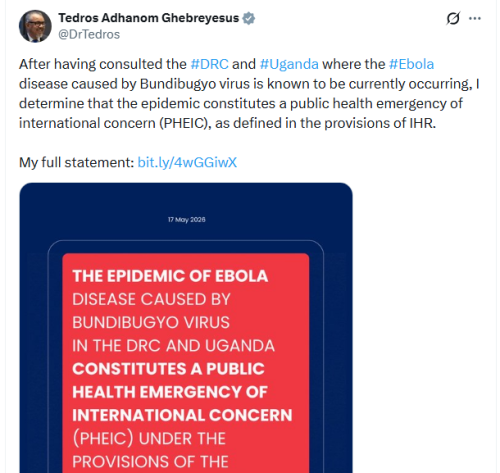
By Emmanuel Rono, May 17, 2026The World Health Organization (WHO) has declared the ongoing Ebola outbreak caused by the Bundibugyo virus a Public Health Emergency of International Concern (PHEIC), following consultations with the Democratic Republic of the Congo and Uganda, where cases of the disease are currently being reported.
In the official determination made public on Sunday, May 17, 2026, the authority noted that the outbreak meets the threshold defined under the International Health Regulations (IHR), requiring coordinated international action to prevent further spread.
The agency added that the outbreak, with around 246 suspected cases and 80 deaths reported, does not meet the criteria of a pandemic emergency.
“After having consulted the #DRC and #Uganda where the #Ebola disease caused by Bundibugyo virus is known to be currently occurring, I determine that the epidemic constitutes a public health emergency of international concern (PHEIC), as defined in the provisions of IHR, but does not meet the criteria of pandemic emergency,” WHO director general Dr Tedros Adhanom Ghebreyesus stated.
Scientific evidence
In his determination, the Director-General has considered, inter alia, information provided by the States Parties – the Democratic Republic of the Congo and Uganda – scientific principles as well as the available scientific evidence and other relevant information; and assessed the risk to human health, the risk of international spread of disease, and the risk of interference with international traffic.
According to WHO, there are now eight laboratory-confirmed cases of the virus, with other suspected cases and deaths across three health zones, including Bunia the capital of Ituri province, and the gold-mining towns of Mongwalu and Rwampara.
The global health agency added that the virus has spread beyond DR Congo, with two confirmed cases reported in neighbouring Uganda.
How Ebola has spread
WHO has confirmed that as of May 16, 2026, eight laboratory-confirmed cases, 246 suspected cases, and 80 suspected deaths have been reported in the Ituri Province of the Democratic Republic of the Congo across at least three health zones, including Bunia, Rwampara, and Mongbwalu.
In addition, two laboratory-confirmed cases (including one death) with no apparent link to each other have been reported in Kampala, Uganda, within 24 hours of each other, on May 15 and 16, 2026, among two individuals travelling from the Democratic Republic of the Congo.
On May 16, 2026, a laboratory confirmed case was also reported in Kinshasa, the Democratic Republic of the Congo, among someone returning from Ituri.
History of Ebola
Ebola was first discovered in 1976 in what is now DR Congo, and is thought to have spread from bats. This is the 17th outbreak of the deadly viral disease in the country.
It is spread through direct contact with bodily fluids and through broken skin, causing severe bleeding and organ failure.
Early symptoms include fever, muscle pain, fatigue, headache and sore throat, and are followed by vomiting, diarrhoea, a rash and bleeding.
There is no proven cure for Ebola, with the average fatality rate is around 50 per cent, according to the WHO.
Africa CDC previously said it was concerned by the high risk of further spread due to the urban settings of Rwampara and Bunia, and mining activities in Mongwalu.