Advertisement
What qualifies as a heat wave in Kenya
Sunday 01st February, 2026 11:49 AM|

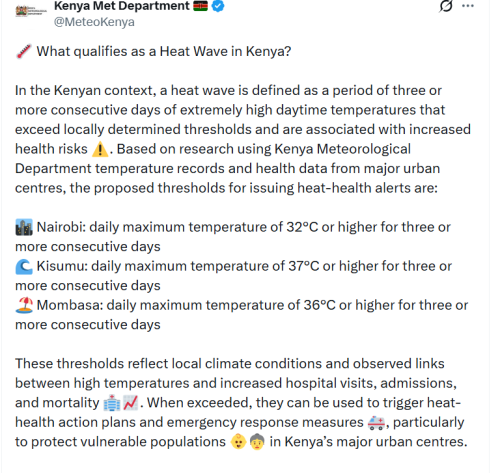
The Kenya Meteorological Department (KMD) has defined specific temperature thresholds that qualify as a heat wave in Kenya’s major urban centres, providing clear criteria to guide public safety and planning.
In a statement issued on February 1, 2026, KMD explained that a heat wave in the Kenyan context is classified as three or more consecutive days of extremely high daytime temperatures exceeding locally determined thresholds, combined with increased health risks.
“In the Kenyan context, a heat wave is defined as a period of three or more consecutive days of extremely high daytime temperatures that exceed locally determined thresholds and are associated with increased health risks,” read the KMD X post in part.
Research using KMD temperature records and hospital data from urban centres established the following thresholds for issuing heat-health alerts: Nairobi, daily maximum of 32°C or higher; Kisumu, daily maximum of 37°C or higher; Mombasa, daily maximum of 36°C or higher, all for three or more consecutive days.
You Might Also Like



“These thresholds reflect local climate conditions and observed links between prolonged high temperatures and rises in hospital visits, admissions, and mortality,” the department said.
When these levels are exceeded, authorities can activate heat-health action plans and emergency measures, especially to protect vulnerable residents.
Seasonal warmth continues across the country
The clarification comes as Kenya experiences the typical seasonal warmth, with January to March historically the hottest months.
KMD noted that current temperatures, though warmer than average in some areas, are consistent with long-term climatology and earlier forecasts.
The department’s latest seven-day outlook, covering January 27 to February 2, 2026, predicts predominantly sunny and dry conditions across most regions.
Isolated light rainfall is expected in parts of the Highlands east and west of the Rift Valley, the Rift Valley itself, Lake Victoria Basin, the Coast, and the south-eastern lowlands.
Public advised
The department urged residents and authorities to use the new thresholds as a guide for assessing heat-related risks and taking preventive measures, particularly for children, the elderly, and those with pre-existing medical conditions.
“With clear criteria in place, communities and local authorities can better plan and respond to extreme heat,” KMD said, highlighting that the thresholds aim to reduce preventable illness and ensure public safety during Kenya’s peak hot season.
Author
Latest News







Advertisement
More on News